Turn a PDF reading into a summary-writing task for your class
Upload a PDF to to teach, choose Summary and set a writing brief for your class. The result is an assignment pupils complete themselves: a response box, feedback and a model answer for comparison. For a science reading, make the brief specific enough to preserve the relationships in the text, not just its vocabulary.
Try the school pond writing task
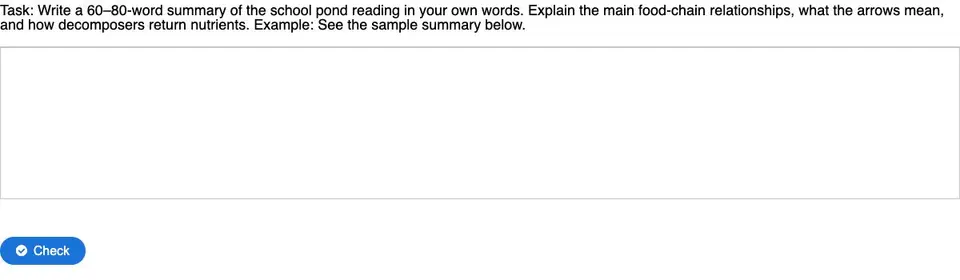
The source PDF explains a food chain: algae, water fleas, small fish and a heron. It also explains the direction of the arrows, the role of decomposers and how several chains connect in a food web. The assignment asks pupils aged 11–13 to condense the reading into 60–80 words, focusing on the feeding relationships, energy transfer and the return of nutrients.
This is a short first exercise in selecting and connecting information. Pupils can leave out the food-web extension because the brief names a narrower focus. They must keep the meaning of the arrows: energy passes from the organism being eaten to the organism that eats it. Reversing that relationship changes the science, even when all the animal names are present.
Read the school pond source PDF
Try the school pond summary-writing task
Upload the passage you want pupils to read
Open the Summary tool and choose Document in the source selector. In the German interface these controls are labelled Zusammenfassung and Dokument. Upload your PDF and save it as the source. The current picker accepts PDF files up to 26 MB. For this example we used a single page of selectable English text and switched off image extraction because the passage contained no diagram needed for the task.
If your reading includes a chart or labelled diagram, keep that source visible to pupils and decide which information they should include. A graph showing a change may carry the main idea that a paragraph only introduces. For a long document, prepare a focused extract before upload so the assignment has a clear reading boundary.
Set a writing brief, not just a topic
Choose the output language and describe the age group, length and content focus in the instruction box. We selected English and requested a 60–80-word summary in pupils’ own words. We named three things to preserve: the main food-chain relationships, the meaning of the arrows and how decomposers return nutrients. We also requested that the model answer stay in the solution section rather than appear in the initial task.
Ask pupils to write their first version in the response box, then open Show solution and compare the two explanations. Before sharing your own assignment, check the model against the PDF: names, quantities and cause-and-effect statements should match the source.
What the model answer keeps
The example model starts with algae using sunlight to make their own food, then condenses the feeding sequence into one sentence. It explains the arrow direction and finishes with bacteria and fungi releasing nutrients from dead organisms. It stays within the requested word range and does not require pupils to reproduce the source’s final food-web sentence.
Use it as one possible response. A pupil can combine the feeding sequence and energy-transfer explanation differently while preserving both. Ask pairs to underline the sentence in each version that explains the arrows, then compare how much repetition each version needs.
Use feedback to revise the explanation
The example checks three configured terms: arrows, decomposers and nutrients. Its feedback reminds pupils to check their explanation when a term is found. The point total records those matches. It is not a grade for whether the whole summary is accurate, well organised or written in the pupil’s own words.
A correct response can also miss a keyword point: the model answer describes bacteria and fungi breaking down dead organisms, but does not use the word “decomposers”. Read the explanation before treating a missing match as a missing idea.
A useful follow-up is to ask pupils to locate the relationship around each term. What do the arrows show? What do decomposers break down? Where do the released nutrients go? A list of the three terms cannot answer those questions. In pairs, pupils point to a sentence that does answer each question and check it against the PDF before revising their response.
Fit the writing into the lesson
Use the PDF during the reading phase and the summary after pupils have identified the main relationships. Let them write before showing the model. Finish with one comparison: which sentence in their first attempt was unclear, and how did they change it? That gives the discussion a specific object rather than asking whether the summary is simply “good”.
If pupils cannot yet follow the feeding sequence, return to the source first. The classroom-chat example based on the same PDF focuses on arrow direction and gives you a question to discuss before independent writing. Once the class understands the relationship, return to the shorter summary task.
Ready to turn this idea into your own lesson material?
Join thousands of teachers who use AI to prep faster, differentiate more easily, and teach more creatively.
GDPR compliant · Ready in 30 sec · No credit card required
Interested in a school license? Book a consultation