Ziele für Nachhaltige Entwicklung

TT
by to-teach Team
7 pages7./8. KlasseGeography, Biology, Science, Sustainable Development Goals (SDG), Economics
Template

Loading preview…

Your worksheet

Add a sustainable development goal. The students then examine this goal in depth and assess the extent to which it has been achieved.

Need an idea?

Popular topics from other teachers

How our AI templates work

  • Content gets adapted

    Examples, texts and tasks match your focus.

  • Method & structure stay

    The didactically reviewed structure of the template won't change.

Description

Zielsetzung: Das Arbeitsblatt vermittelt vertiefendes Wissen über eines der 17 Ziele für Nachhaltige Entwicklung der Vereinten Nationen. Die Lernenden entwickeln ein Verständnis für die Relevanz des ausgewählten Ziels und können diese auch erklären. 

Inhalte und Methoden: Das Arbeitsblatt informiert über die Grundlagen des ausgewählten Zieles und den aktuellen Stand in diesem Bereich. Methodisch werden Informationstexte, Aufgaben zum Textverständnis (Multiple-Choice-Fragen) und offene Fragestellungen eingesetzt. Als Bonus ist eine eigene Reflexionsaufgabe über Verhaltensweisen, welche zur Erreichung der 17 Ziele beitragen, angefügt.

Kompetenzen:

  • Sachkompetenz: Die Schüler:innen erwerben Wissen über die Bedeutung eines ausgewählten Ziels und Maßnahmen, welche zur Erreichung ergriffen werden.
  • Methodenkompetenz: Die Schüler:innen üben das Lesen und Verstehen von Informationstexten, das Beantworten von Fragen und das Verfassen von kurzen Texten. 

Zielgruppe und Niveau: 7./8. Klasse
Similar worksheets

Understanding Influencer Marketing

Understanding Influencer Marketing

This worksheet aims to raise students’ awareness of the mechanisms, economic dimensions, and psychological strategies of modern digital marketing in everyday life.

Content and Methods: The material focuses on the economic significance of social media marketing based on statistical data, as well as the analysis of specific digital posts. Methodologically, the worksheet relies on a combination of practical case studies—in which an exemplary social media post is deconstructed both textually and statistically—and theoretical insights into behavioral economic effects. In addition, the material encourages multi-perspective discussion through reflective writing assignments and the comparison of contrasting stakeholder perspectives. Finally, the discussion of complex issues is used to synthesize what has been learned into the formation of independent judgments.

Competencies:

Analytical and Deconstructive Competence: The ability to systematically examine media content and linguistic and statistical devices for their manipulative or promotional effects

Reflective and Critical Thinking Competence: The ability to critically examine one’s own consumer behavior and evaluate economic phenomena from different perspectives

Media and Economic Competence: Understanding of digital market mechanisms, psychological influence strategies such as the authority bias or the bandwagon effect, and their impact on the economy

Target Audience and Level: 9th/10th grade

EconomicsPolitics
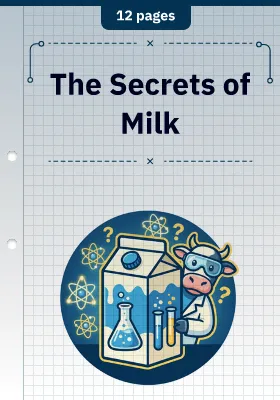
The Secrets of Milk

The Secrets of Milk

Objective: This workbook explores a historical and materials-science phenomenon: the production of casein, an early milk-based bioplastic. Students work as a team of researchers to investigate how the organic components of liquid cow’s milk can be transformed into a solid plastic through the action of acid.


Content and Methods: The content is conveyed through a combination of historical contextualization, experimental laboratory work, and material analysis: Starting with the question of how a solid material can be produced from milk, students explore the composition of milk and the effect of acids on proteins. They then experimentally extract casein, document the course of the reaction, and examine the properties of the resulting bioplastic. Finally, the results are used in a scientific application to evaluate the historical significance and material properties of casein as an alternative to plastic.


Competencies:

  • Technical expertise: Understanding of protein denaturation (acid precipitation of milk protein/casein) and the classification of galalith as a historical bioplastic
  • Knowledge acquisition: Planning, conducting, and systematically documenting a preparative organic chemistry experiment (filtration, solid isolation)
  • Materials and testing skills: Criteria-based analysis of the physical properties of a self-produced solid
  • Argumentation and language skills: Writing a technically sound report using precise scientific explanations


Target audience and level: Middle school

BiologyChemistry
The Green Battery

The Green Battery

Objective: This worksheet explores the electrochemical fundamentals of galvanic cells and how a lemon battery works in the context of modern, sustainable technology development. Students take on the role of a startup research team to experimentally and ecologically evaluate the suitability of a lemon as an environmentally friendly electrolyte, as well as the efficiency of various electrode pairings.


Content and Methods: The content is taught by combining theoretical fundamentals, experimental data collection, error analysis, and sustainability assessment: First, students explore the structure and functioning of electrochemical cells as well as the underlying redox reactions. They then test their hypotheses in an experiment, document measurement data, and analyze typical sources of error in the laboratory. Finally, they evaluate the performance and sustainability of various materials before summarizing their results in a technical report and a persuasive presentation.


Competencies:

  • Technical Competence: Understanding of redox reactions, electrode potentials, and the role of electrolytes in generating electrical power
  • Data Analysis: Conducting quantitative electrochemical measurements, systematically comparing variables, and identifying sources of methodological error
  • Evaluation Competence: Balancing maximum technical performance with environmental factors (extraction, recycling, toxicity) in the context of sustainable chemistry
  • Communication skills: Targeted, audience-oriented presentation of laboratory data for a business analysis or an investor pitch


Target audience and level: Middle School

BiologyChemistry