to teach logo
Sign up

Das antike Griechenland und die griechische Kultur

TT
by to-teach Team
5 pagesAb der 5. KlasseHistory, Philosophy
Template

Loading preview…

Your worksheet

Insert an aspect of Greek heritage here. The pupils then explore this in more depth in a text.

Need an idea?

Popular topics from other teachers

How our AI templates work

  • Content gets adapted

    Examples, texts and tasks match your focus.

  • Method & structure stay

    The didactically reviewed structure of the template won't change.

Description

Zielsetzung: Das Arbeitsblatt bietet einen umfassenden Einblick in die Geschichte und Kultur des antiken Griechenlands, indem es grundlegendes Wissen über politische Errungenschaften, Philosophie, Mathematik und Alltagsleben vermittelt. Es zielt darauf ab, die Schüler:innen für den nachhaltigen Einfluss der griechischen Antike auf die moderne Welt zu sensibilisieren.

Inhalte und Methoden:

Das Arbeitsblatt beginnt mit einem Einführungstext zum antiken Griechenland. Ein YouTube-Video namens "Das antike Griechenland in 120 Sekunden" ergänzt diese Informationen. Wahr-Falsch-Fragen überprüfen das Wissen über die Chronologie, die politischen Strukturen und literarische Werke des antiken Griechenlands. Ein fiktiver Brief widmet sich einer ausgewählten Errungenschaft aus dem antiken Griechenland. Multiple-Choice-Fragen überprüfen das Textverständnis. Im Bonus-Teil ergänzt ein Video von "Checker Tobi" das Wissen der Schüler:innen um weitere Details zum Alltag, zu Bildung und zur Religion im antiken Griechenland. Ein Lückentext soll anhand des Videos ausgefüllt werden. Dazu gibt es ein Wortsuchrätsel.

Kompetenzen:

  • Den Einfluss der griechischen Kultur auf die eigene Lebenswelt beurteilen
  • die Übertragbarkeit historischer Erkenntnisse auf aktuelle Probleme und mögliche Handlungsoptionen für die Zukunft erörtern
  • bei der Analyse, Strukturierung und Darstellung von historischen Sachverhalten Fachbegriffe anwenden 

Zielgruppe und Niveau: Ab der 5. Klasse

Similar worksheets
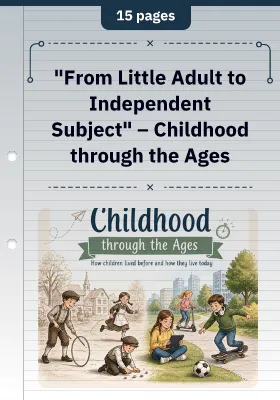
"From Little Adult to Independent Subject" – Childhood through the Ages

"From Little Adult to Independent Subject" – Childhood through the Ages

This worksheet aims to provide trainee teachers with a historically informed and socially critical understanding of the life stage known as ‘childhood’. Learners are to be made aware that childhood is not a rigid, biological state, but is subject to constant social change. They will learn to analyse historical patterns of upbringing and living environments, to contextualise the contemporary view of the child (including the UN Convention on the Rights of the Child), and to draw conclusions for their own professional approach by comparing the past and the present.

Content and methods:

This worksheet combines historical text analysis, the development of empathy, analysis of contemporary issues and research into international law. Following a personal reflection and an analysis of a historical period, the pupils write a fictional diary entry from a child’s perspective and contrast this with the reaction of a child today. They then map out the cornerstones of modern childhood in a practical matrix and compare historical and contemporary living conditions. The activity concludes with research into the UN Convention on the Rights of the Child, including its historical context, and a reflection on their own pedagogical approach.


Competencies:

Learners can...

  • Explain the concept of childhood as a socially shaped and historically changeable construct.
  • Analyse children’s historical living environments in terms of educational objectives, work requirements and legal status, guided by specific criteria.
  • Develop historical empathy through methods of shifting perspectives and reflect on different living conditions from multiple perspectives.
  • Identify the dimensions of modern childhood (including subject status, institutionalisation and mediatisation) and illustrate them using concrete examples from practice.
  • Independently research articles of the UN Convention on the Rights of the Child, place them in their historical context and relate them to today’s image of the child.
  • Use historical insights to critically examine current patterns of upbringing and apply them to one’s own professional approach.


Target group and level:

Adult students or trainees in the field of social pedagogy, particularly aspiring educators.


Note: Internet access is required for the research task

PedagogySocial PedagogyHistoryHealth and Social Care
Theories - Applying and Exploring Them in Depth

Theories - Applying and Exploring Them in Depth

The worksheet aims to provide students with a deep understanding of a pedagogical theory. Students apply central technical terms, transfer theoretical concepts to pedagogical scenarios, and reflect on the relevance of the theory for practical application.

Content and methods:

The focus is on the application, in-depth exploration, and critical reflection of an educational theory. Methodologically, the worksheet combines the translation of technical terms into everyday language, cooperative group work via an expert group method, the elaboration and presentation of subject-specific content, the development of practical case studies, the analysis of different positions and arguments, as well as a concluding reflection and self-assessment.

Competencies:

  • Apply and explain central terms and concepts of a theory
  • Comprehend, structure, and summarize specialized texts
  • Transfer theoretical content to pedagogical situations and case examples
  • Analyze and evaluate professional positions and arguments
  • Formulate and justify personal judgments
  • Reflect on and assess one's own learning progress

Target group and level:

Adult students or trainees in the field of social pedagogy, particularly aspiring educators.

Note on further work: The worksheet serves to deepen and apply a pedagogical theory. It can build upon an introductory worksheet and forms the foundation for further tasks in which theoretical concepts are applied to more complex practical examples and critically reflected upon. Introductory worksheet on the topic: Theories – Fundamentals


Note: Internet access is required for the group research phase.
PedagogyPhilosophyEthicsSocial PedagogyHealth and Social Care
Jigsaw Activity: Philosophers and their Theories

Jigsaw Activity: Philosophers and their Theories

Objectives

The goal is to learn the Jigsaw method as a way to independently explore complex philosophical models of thought. Participants engage objectively and critically with fundamental questions of existence and evaluate them through academic discussion. The sample content serves as a flexible template for systematic method training.

Content and Methods

This Worksheet uses a cooperative Jigsaw structure to explore core philosophical ideas. After an individual specialization phase, students deepen their knowledge in expert groups and then share it in home groups. Results are organized in a table that highlights major works and key theses. A short, fictional role-play at the end places each position in a contemporary context. All content choices - both the selection of philosophers and the theories - are designed to be interchangeable.

Competencies

  • Subject Knowledge: Understanding central philosophical movements and the ability to concisely summarize complex models of thought.
  • Methodological Skills: Confident use of the Jigsaw method as a cooperative learning approach and proficiency in focused academic research.
  • Critical Judgment: Objective engagement with differing worldviews and their relevance for contemporary epistemology.
  • Social and Communication Skills: Responsible peer-to-peer knowledge sharing and facilitation of perspective-taking through role-play.

Target Group and Level

Middle and upper secondary

Englishnon-subject specific contentPhilosophyEthics