Die Entstehung und Förderung von Nationalparks

TT
by to-teach Team
5 pagesMittelstufeGeography, Politics
Template

Loading preview…

Your worksheet

Enter the name of a national park.

Need an idea?

Popular topics from other teachers

How our AI templates work

  • Content gets adapted

    Examples, texts and tasks match your focus.

  • Method & structure stay

    The didactically reviewed structure of the template won't change.

Description

Zielsetzung: Das übergeordnete Lernziel des Arbeitsblattes ist es, Schüler:innen die Entstehung und Förderung von Nationalparks näherzubringen, insbesondere am Beispiel eines ausgewählten Nationalparks, und sie für die Bedeutung des Naturschutzes sowie die Herausforderungen bei der Verwaltung von Nationalparks zu sensibilisieren. Das Arbeitsblatt zielt zudem darauf ab, eine kritische Auseinandersetzung mit der staatlichen Förderung von Nationalparks zu ermöglichen.


Inhalte und Methoden: Das Arbeitsblatt behandelt die Gründung und Entwicklung von Nationalparks, die Rolle von Park Ranger:innen, Finanzierungsmodelle und Nachhaltigkeitsmaßnahmen in Nationalparks. Ein zentrales Element ist die Diskussion der Vor- und Nachteile der staatlichen Förderung von Nationalparks. Methodisch setzt das Arbeitsblatt auf das Anhören von Audioinhalten (Radiosendung, Anrufer:innenbeiträge) über QR-Codes, um Hörverständnis zu schulen. Dies wird ergänzt durch Multiple-Choice-Fragen zur Wissensüberprüfung und offene Aufgaben, die zur Meinungsbildung und Argumentation anregen.


Kompetenzen:

  • Hörverstehen und Informationsentnahme aus auditiven Medien
  • Wissenserwerb und -verständnis bezüglich Nationalparks und Naturschutz
  • Kritisches Denken und Meinungsbildung zur staatlichen Förderung von Nationalparks
  • Argumentationsfähigkeit (Pro und Kontra)
  • Textverständnis


Zielgruppe und Niveau: 8.-10. Klasse
Similar worksheets

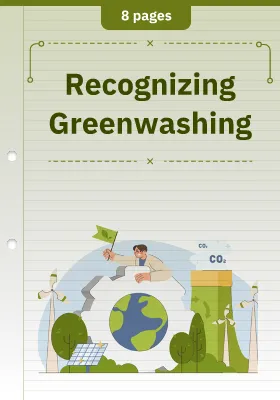
Recognizing Greenwashing

Recognizing Greenwashing

The goal of this worksheet is to enable students to independently identify and critically examine manipulative marketing strategies in retail. Using a specific case study, they will develop the theoretical foundation needed to distinguish between genuine sustainability promises and deliberate consumer deception, so they can make informed, independent consumer decisions in their daily lives.

Content and Methods: The content focuses on the definition and strategic characteristics of greenwashing, its psychological impact, and an analysis of legal consequences. Methodologically, the worksheet combines an image-based case analysis with in-depth journalistic text analysis. A video-based summary of theoretical categories of deception and a practical, criteria-based checklist serve to reinforce knowledge and facilitate active application to students’ own consumer behavior.

Competencies:

Analytical Competence: Students can systematically deconstruct visual design elements, price placements, and advertising messages in digital user interfaces.

Substantive Competence: They understand the definition of the technical term “greenwashing” and can distinguish between vague marketing phrases and verifiable sustainability labels.

Critical thinking skills: Students are able to critically evaluate the discrepancy between corporate sustainability reports and actual environmental impacts.

Reflective thinking skills: They can critically examine their own susceptibility to manipulative sales strategies and identify alternative courses of action.

Target audience and grade level: Intermediate (8th-10th grade)


EconomicsGeography
Understanding Influencer Marketing

Understanding Influencer Marketing

This worksheet aims to raise students’ awareness of the mechanisms, economic dimensions, and psychological strategies of modern digital marketing in everyday life.

Content and Methods: The material focuses on the economic significance of social media marketing based on statistical data, as well as the analysis of specific digital posts. Methodologically, the worksheet relies on a combination of practical case studies—in which an exemplary social media post is deconstructed both textually and statistically—and theoretical insights into behavioral economic effects. In addition, the material encourages multi-perspective discussion through reflective writing assignments and the comparison of contrasting stakeholder perspectives. Finally, the discussion of complex issues is used to synthesize what has been learned into the formation of independent judgments.

Competencies:

Analytical and Deconstructive Competence: The ability to systematically examine media content and linguistic and statistical devices for their manipulative or promotional effects

Reflective and Critical Thinking Competence: The ability to critically examine one’s own consumer behavior and evaluate economic phenomena from different perspectives

Media and Economic Competence: Understanding of digital market mechanisms, psychological influence strategies such as the authority bias or the bandwagon effect, and their impact on the economy

Target Audience and Level: 9th/10th grade

EconomicsPolitics