to teach logo
Sign up

Wer bestimmte in Rom?

TT
by to-teach Team
6 pagesAb der 5. KlasseHistory
Template

Loading preview…

Your worksheet

Add your own characters, names or places and create a unique learning experience.

Need an idea?

Popular topics from other teachers

How our AI templates work

  • Content gets adapted

    Examples, texts and tasks match your focus.

  • Method & structure stay

    The didactically reviewed structure of the template won't change.

Description

Zielsetzung: Das Arbeitsblatt vermittelt ein grundlegendes Verständnis der sozialen Struktur der Römischen Republik, insbesondere der Rolle und des Lebens einer ausgewählten Gesellschaftsgruppe. Es zielt darauf ab, die Schüler:innen in die Lage zu versetzen, die Rechte und Pflichten dieser sozialen Gruppe zu verstehen, sie mit ihrem eigenen Leben zu vergleichen und die breiteren Aspekte des Alltags im alten Rom kennenzulernen.

Inhalte und Methoden: Das Arbeitsblatt beginnt mit einer Einführung aus der Perspektive eines 10-jährigen Kindes aus der ausgewählten Gesellschaftsgruppe im alten Rom. Durch einen Tagebucheintrag und eine kurze Ansprache erfahren die Schüler:innen mehr über das Leben, die Rechte und Pflichten der sozialen Gruppe. Ein Multiple-Choice-Test überprüft das Textverständnis der Schüler:innen. Anschließend fassen sie in einem kurzen Text die besonderen Rechte und Pflichten der sozialen Gruppe zusammen. Der Bonus-Teil erweitert das Thema mit einem Video von "Checker Tobi" über den Alltag im alten Rom. Ein Lückentext soll anhand der Informationen aus dem Video ausgefüllt werden. Abschließend sollen die Schüler:innen vorgegebene Wörter zu korrekten Sätzen über das alte Rom anordnen.

Kompetenzen:

  • Wichtige Gruppen in den jeweiligen Gesellschaften unterscheiden sowie deren Funktionen, Interessen und Handlungsmöglichkeiten beschreiben
  • Historisches Sachwissen: Schüler:innen erwerben Kenntnisse über die soziale Schichtung der Römischen Republik, die Rolle einer ausgewählten sozialen Gruppe und allgemeine Aspekte des römischen Alltags. 

Zielgruppe und Niveau: Ab der 5. Klasse
Similar worksheets

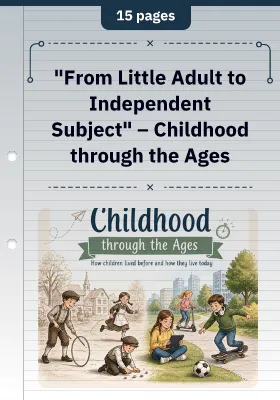
"From Little Adult to Independent Subject" – Childhood through the Ages

"From Little Adult to Independent Subject" – Childhood through the Ages

This worksheet aims to provide trainee teachers with a historically informed and socially critical understanding of the life stage known as ‘childhood’. Learners are to be made aware that childhood is not a rigid, biological state, but is subject to constant social change. They will learn to analyse historical patterns of upbringing and living environments, to contextualise the contemporary view of the child (including the UN Convention on the Rights of the Child), and to draw conclusions for their own professional approach by comparing the past and the present.

Content and methods:

This worksheet combines historical text analysis, the development of empathy, analysis of contemporary issues and research into international law. Following a personal reflection and an analysis of a historical period, the pupils write a fictional diary entry from a child’s perspective and contrast this with the reaction of a child today. They then map out the cornerstones of modern childhood in a practical matrix and compare historical and contemporary living conditions. The activity concludes with research into the UN Convention on the Rights of the Child, including its historical context, and a reflection on their own pedagogical approach.


Competencies:

Learners can...

  • Explain the concept of childhood as a socially shaped and historically changeable construct.
  • Analyse children’s historical living environments in terms of educational objectives, work requirements and legal status, guided by specific criteria.
  • Develop historical empathy through methods of shifting perspectives and reflect on different living conditions from multiple perspectives.
  • Identify the dimensions of modern childhood (including subject status, institutionalisation and mediatisation) and illustrate them using concrete examples from practice.
  • Independently research articles of the UN Convention on the Rights of the Child, place them in their historical context and relate them to today’s image of the child.
  • Use historical insights to critically examine current patterns of upbringing and apply them to one’s own professional approach.


Target group and level:

Adult students or trainees in the field of social pedagogy, particularly aspiring educators.


Note: Internet access is required for the research task

PedagogySocial PedagogyHistoryHealth and Social Care