

My body belongs to me
8

The world of Start Ups
5

AI skills
26

Substitute Lessons
16

Countdown to Summer
9

Focus on women
6
Filters
Worksheets
Recognizing Greenwashing
The goal of this worksheet is to enable students to independently identify and critically examine manipulative marketing strategies in retail. Using a specific case study, they will develop the theoretical foundation needed to distinguish between genuine sustainability promises and deliberate consumer deception, so they can make informed, independent consumer decisions in their daily lives.
Content and Methods: The content focuses on the definition and strategic characteristics of greenwashing, its psychological impact, and an analysis of legal consequences. Methodologically, the worksheet combines an image-based case analysis with in-depth journalistic text analysis. A video-based summary of theoretical categories of deception and a practical, criteria-based checklist serve to reinforce knowledge and facilitate active application to students’ own consumer behavior.
Competencies:
Analytical Competence: Students can systematically deconstruct visual design elements, price placements, and advertising messages in digital user interfaces.
Substantive Competence: They understand the definition of the technical term “greenwashing” and can distinguish between vague marketing phrases and verifiable sustainability labels.
Critical thinking skills: Students are able to critically evaluate the discrepancy between corporate sustainability reports and actual environmental impacts.
Reflective thinking skills: They can critically examine their own susceptibility to manipulative sales strategies and identify alternative courses of action.
Target audience and grade level: Intermediate (8th-10th grade)

Hacer vacaciones - Nivel A1
Objective: This worksheet aims to provide students with basic information about a country as a travel destination and to enable them to talk about their own vacation experiences.
Content and Methods: It describes the geography, climate, sights, and the importance of tourism within the country. Methods include reading comprehension, true/false questions, and a structured writing task about the students’ own vacations.
Competencies:
- Reading comprehension
- Geographical knowledge
- Written expression
Target Audience and Level: Spanish learners at A1 level
La diversidad del español - Nivel A2
Objective: This worksheet aims to familiarize students with linguistic diversity in Spanish. It is designed to raise awareness of the coexistence of Spanish and other languages in Spanish-speaking regions and to encourage students to engage creatively with the topic of multilingualism.
Content and Methods: A text explains the linguistic situation in a Spanish-speaking region. It also addresses new language trends such as Spanglish and neologisms. The worksheet includes multiple-choice questions, word identification exercises, and a creative group activity in which students are asked to invent their own language.
Competencies:
Linguistic knowledge: Understanding of multilingualism and language contact
Critical thinking: Reflection on the development of languages
Creativity: Inventing words and a new language
Target audience and level: Spanish learners at A2 level
La vida en un país hispanohablante - Nivel A2
Objective: This worksheet aims to help students understand life in a Spanish-speaking country and enable them to describe their own country.
Content and Methods: It covers attitudes toward life, social dynamics (generational conflicts, marginalized groups), migration, and the importance of tourism in a selected country. Methods include reading comprehension, selecting specific statements from the text, and a structured task to describe one’s own country.
Competencies:
- Reading comprehension
- Understanding of sociocultural and geographical aspects
- Written expression
Target group and level: Spanish learners at A2 level
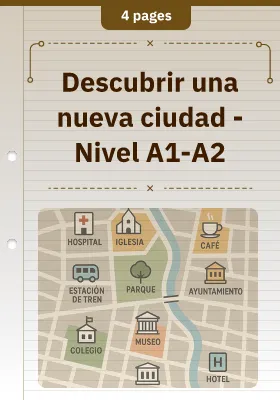
Descubrir una nueva ciudad - Nivel A1-A2
Objective: This worksheet aims to teach learners how to describe a city in Spanish using information from various sources.
Content and Methods: It includes a picture description, listening comprehension exercises based on a dialogue about a selected city, description tasks, and instructions for describing one’s own city.
Competencies:
- Picture description
- Listening and reading comprehension
- Written expression
- Analysis of information
Target audience and level: Spanish learners at A1/A2 level
Economic impact of major events
Learners critically examine the economic, social, and environmental consequences of large-scale events using a selected example and weigh up the opportunities and risks.
Contents and methods:
Based on informational texts about various roles (e.g., city administration, citizens' initiative, environmental officers), learners develop subject-specific arguments. The method includes preparing a structured discussion using tables and concluding with the creation of an informational statement to announce the decision.
Skills:
- Multiperspective analysis of complex economic issues
- Argumentation and judgment skills in socio-political debates
- Transfer of theoretical economic data to municipal decision-making processes
- Cooperation and communication skills within a role simulation
Target group:
Grade 8 and above
The impact of AI on the environment
Objective: The worksheet aims to raise learners' awareness of the environmental impact of artificial intelligence (AI). It trains them to critically analyse the energy and resource consumption of data centres in order to develop strategies for the environmental sustainability of AI technology, particularly through the use of renewable energies.
Contents and methods: The worksheet begins with a warm-up on the learners' personal attitudes towards AI and climate change, followed by information about AI data centres in a selected country/city. Learners analyse advantages and environmental risks using text and cause-and-effect analyses. Methods such as group research, perspective changing and decision-making encourage reflection on sustainability and concrete measures for environmental responsibility.
Competencies:
- Sustainability awareness: Understanding the ecological footprint of digital technologies (energy and resource consumption).
- Critical analysis: Weighing technological advantages (climate research, smart farming) against environmental risks.
- Problem solving: Developing concrete strategies to promote energy efficiency and the use of green energy sources for AI.
- Understanding of roles: Making informed political decisions from an environmental policy perspective.
Target group and level: Years 8–10 (middle school)
ESD:
- 12: Responsible consumption and production patterns: This addresses the challenge of raw material extraction (rare earths) and the need for recycling and sustainable procurement.
- 13: Climate action: The text highlights the role of AI in reducing global emissions and in climate research.

AI Detective: AI and its usage in a specific field
Students investigate how artificial intelligence is transforming a specific field, gaining an understanding of both the benefits and challenges of AI. The goal is to develop critical awareness of AI’s capabilities, ethical issues, and the ongoing need for human judgment in decision-making.
Content and Methods:
The worksheet guides students through an exploration of AI in a specific field by examining real-world examples. Students analyze ethical concerns. Methods include comprehension questions, multiple-choice tasks, comparison of benefits and risks, open-ended reflection questions, and a short argumentative essay about AI’s role in that field.
Competencies:
- Understanding technological applications of AI in a real-world professional field
- Critical evaluation of the benefits and risks of AI in that field
- Ethical reasoning about data privacy, bias, and human–machine interaction
- Analytical thinking about the balance between AI capabilities and human expertise
- Argumentative and reflective writing skills
Target Group and Level:
Grade 8 and up.
Films in the classroom: Brochure
With the help of the worksheet, learners engage with a film in a structured way in order to develop a deeper understanding and to reflect on and transfer what they have seen.
Contents and methods:
The worksheet is structured like a brochure and asks questions about the content and further questions about the film. The worksheet ends with a personal evaluation of the film.
Skills:
- Concentrated extraction of information from a visual medium
- Analysis, reflection and transfer of film content
Target group and level:
Grade 7 and above
SWOT Analysis
The worksheet aims to teach the SWOT analysis method and enable learners to apply it independently to a relevant socio-political topic.
Contents and methods:
Learners are introduced to SWOT analysis, explaining the meaning of the four areas (strengths, weaknesses, opportunities, threats). They then apply the method to a selected topic by reading an informative text on it and structuring the relevant aspects in a predefined SWOT matrix. Finally, learners evaluate the topic based on their analysis and justify their assessment.
Skills:
- Application of SWOT analysis as a structured research tool
- Analytical thinking and systematic problem identification
- Critical reading and understanding of complex texts
- Ability to argue and justify
- Engagement with socio-political debates
Target group and level:
Grade 9 and above
Commitment & Responsibility
Learners explore the concept of engagement and responsibility, particularly in the context of a selected topic, and develop their own ideas for active engagement.
Contents and methods:
The worksheet highlights the importance of a specific topic for society and shows different perspectives and personal advantages of social engagement. Learners reflect on their own connection to the topic, read an informational text and develop concrete ideas for action to get involved in the selected area. Ideas for possible actions are provided and reflection on experiences is encouraged.
Skills:
- Reflective ability and self-awareness
- Critical thinking and analytical skills
- Problem solving and idea development
- Sense of responsibility and decision-making skills
- Communication and cooperation skills (implied by the opportunity to engage with others)
Target group and level:
Grade 7 and above
Films in the classroom
With the help of the worksheet, learners engage with the content of a film in a structured manner before, during and after viewing it in order to develop a deeper understanding and to reflect on and transfer what they have seen.
Content and methods:
The worksheet begins by testing prior knowledge of the film. While watching, the pupils complete multiple-choice tasks to actively engage with and consolidate their understanding. After the film, transfer tasks are used for further processing and reflection on the topic.
Skills:
- Activating and building on prior knowledge
- Concentrated extraction of information from a visual medium
- Analysis, reflection and transfer of film content
Target group and level:
Grade 7 and above
Fetching more worksheets...
Next Page