
Turn a YouTube video into a classroom script for post-viewing discussion
To turn a YouTube video into a classroom script, add the video as a source in to teach, choose a written format and describe what pupils should explain after watching. The script gives small groups a reason to revisit the film: each speaker has to explain a different part, and listeners compare the explanations with the original.
Try a four-role script after viewing
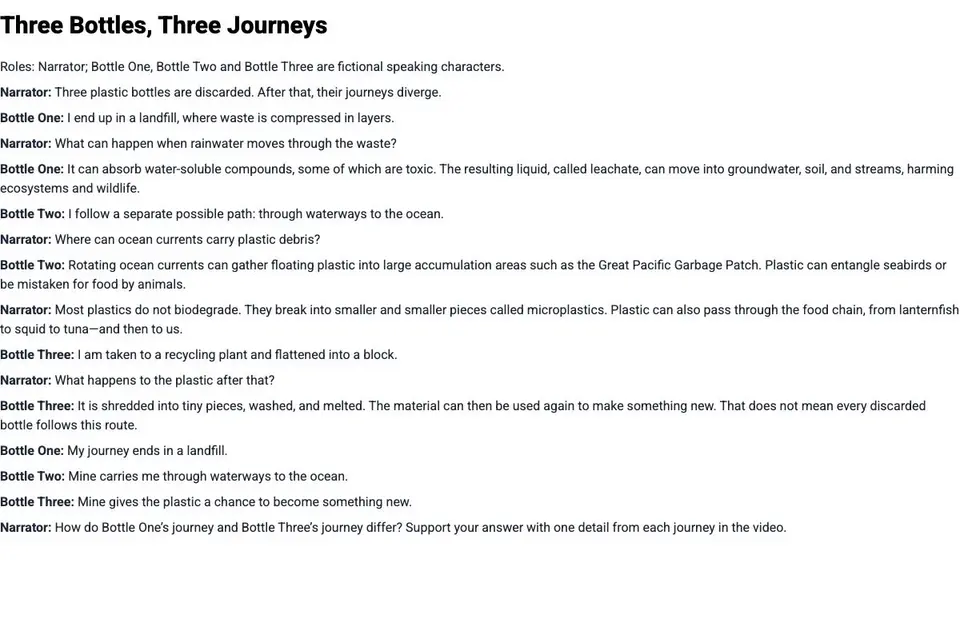
This example uses TED-Ed’s “What really happens to the plastic you throw away”, by Emma Bryce. The four-minute animation follows three plastic bottles along different possible journeys. Our English script gives a narrator and three fictional bottle characters a speaking role. Use it with pupils aged 12–14 after watching the film, when they are ready to explain how an outcome follows from a sequence of events.
Watch the original TED-Ed video
Original lesson and creator credits
Read the four-role classroom script
Import the video and choose the relevant section
Open the text-format tool, open the source selector and choose Video. Paste the YouTube URL, select the language spoken in the video and save the source. The imported video appears beside the tool with start and end sliders. For this example, we used the full 00:00–04:07 range so all three journeys remained available. For a longer film, choose a section that includes the explanation pupils will need, rather than only its conclusion.
Create a script from your video
Choose roles that make the explanation easier to follow
Set the output language to English and choose Script from the format menu. In the German interface, the option is labelled Drehbuch. Put the class age, speaking roles, approximate length and essential ideas into the instruction box. These are instructions you write; they are not separate age or length sliders.
Our instruction asked for four roles—Narrator, Bottle One, Bottle Two and Bottle Three—and roughly 350 words in fresh wording. It specified three separate journeys, the fact that smaller plastic fragments remain plastic, and the order of the recycling stages. It also asked for a final comparison question. Those requirements shape an explanation pupils can discuss instead of a collection of loosely related facts.
Make the dialogue readable aloud
The first version gave each bottle a long speech. We used the AI revision control to divide those speeches into shorter turns, with a narrator question between them. This lets the group pause at a meaningful point: what happens next, and why does it matter? The roles still explain the same processes, but pupils no longer have to read an entire paragraph before another speaker joins in.
We also changed a transition that could suggest the second bottle travelled away from the landfill. Bottle Two represents a separate possible journey through waterways to the ocean. In your own adaptation, review transitions such as then, another and next carefully: a small wording change can turn alternative examples into one sequence.
Give listeners a task as well as speakers
Before the film, ask pupils to listen for three destinations: landfill, ocean and recycling. After watching, divide the class into groups of four and assign the script roles. Pause after each bottle’s section so the group can note the cause and the consequence. For example, rain passing through landfill waste produces polluted liquid; the recycling section describes a sequence that changes discarded bottles into material for another use.
After the reading, each group chooses two journeys and completes: “These journeys differ because … The part of the video that supports our explanation is …” Replay the relevant section when pupils disagree. The point is to explain a relationship, not simply remember which character said a word.
Use the original video to settle questions
Return to the landfill section from about 01:10, the ocean section from about 01:54, and recycling from about 03:12. Ask pupils to check one claim at a time. Are the bottles following different paths? Does breaking into smaller pieces make plastic disappear? Are the recycling stages in the right order? These questions make the original film part of the activity throughout the lesson.
The talking bottles are fictional classroom roles, and their lines are newly written. Keep that distinction clear when pupils cite evidence: they should point to the film’s explanation, not treat a character’s speech as a quotation from its narrator. If your lesson depends on a diagram or an action shown only on screen, pause the original video and discuss that visual directly.
Adjust the follow-up for your class
For pupils who need language support, provide three destination headings and the connectors first, because and as a result. Let them rehearse their explanation with those prompts before the group reading. For pupils ready for more, remove the headings and ask them to compare two consequences in their own words. Both tasks return to the same source and the same scientific relationships.
Connect the script to the rest of the lesson
In a lesson plan, place the video in the exploration phase, the group reading in the explanation phase and an individual comparison at the end. Keep the final written response short enough to see whether each pupil can explain the difference independently. In to teach, the same source can support a second material format when the lesson needs it: choose flashcards for recall or a supporting reading when pupils need the explanation in prose.
Use the share control on the finished material to open its pupil-facing link. The linked example is available to read alongside the original film. When you adapt a different video, keep the video link beside the task so pupils can return to the source during discussion.
Create post-viewing flashcards
Bereit, diese Idee in eigenes Unterrichtsmaterial umzusetzen?
Schließe dich tausenden Lehrkräften an und bereite deinen Unterricht mit KI schneller, differenzierter und kreativer vor.
DSGVO-konform · In 30 Sek. startklar · Keine Kreditkarte nötig
Du interessierst dich für eine Schullizenz? Beratungsgespräch vereinbaren