Setting Boundaries and Saying No
Loading preview…
Choose a situation where you would actually like to say No.
How our AI templates work
Content gets adapted
Examples, texts and tasks match your focus.
Method & structure stay
The didactically reviewed structure of the template won't change.
Description
Objective:
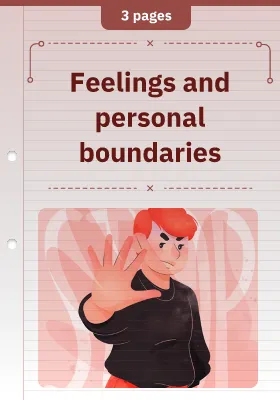
Learners learn to recognize and effectively communicate personal boundaries. The goal is to convey the importance of saying "No" as an act of self-protection and self-respect, empowering them to set boundaries clearly and politely in various situations.
Content and Methods:
The worksheet explains setting personal boundaries as a means of protecting one's well-being. It provides examples of physical, emotional, and digital boundaries. A case study serves as a basis for practicing how to say "No" clearly but politely. Learners reflect on the feelings that arise when saying "Yes" against their will and when saying "No." In partner work, situations where boundaries were unintentionally or deliberately crossed are discussed. Finally, learners identify trusted individuals and resources. Methods include text analysis, brainstorming, case studies, reflection questions, and partner work.
Competencies:
- Recognizing and naming personal boundaries
- Applying techniques for saying "No" in various situations
- Self-reflection on feelings when setting boundaries
- Analyzing situations where boundaries are crossed
- Identifying trusted individuals and resources
Target Group and Level:
Grade 7 and up
Note:
Worksheet 2 of 4 from the series "My Body Belongs to Me" - Middle School Level