Res cogitans vs. Res extensa - Der cartesianische Dualismus

TT
by to-teach Team
8 pagesGrundkursEthics, Philosophy
Template

Loading preview…

Your worksheet

List a theory on the topic of mind and body that is different from Descartes'. Also name the philosopher behind the theory.

Need an idea?

Popular topics from other teachers

How our AI templates work

  • Content gets adapted

    Examples, texts and tasks match your focus.

  • Method & structure stay

    The didactically reviewed structure of the template won't change.

Description

Zielsetzung: Ziel ist das Kennenlernen des cartesianischen Dualismus und die kritische Analyse des Leib-Seele-Problems. Die Lernenden vergleichen die Substanzentrennung mit einer weiteren Theorie und bewerten deren Relevanz für moderne Technologien wie KI und Neuro-Enhancement.

Inhalte und Methoden: Das Arbeitsblatt vermittelt Grundbegriffe und analysiert Descartes’ Substanzenlehre (res cogitans vs. res extensa). Methodisch werden das Interaktionsproblem und Gegenentwürfe durch Fallarbeit, Gehirn-Simulationen und Diskussionen zu Virtual Reality erschlossen. Die Ergebnissicherung erfolgt über Tabellen, Mindmaps und Argumentationen.

Kompetenzen:

  • Fach- & Analysekompetenz: Unterscheidung philosophischer Strömungen sowie Dekonstruktion der Kategorien „Denken“ und „Ausdehnung“ in ihrem historischen Kontext
  • Transferkompetenz: Anwendung historischer Positionen auf anthropologische Fragen des digitalen Zeitalters (z. B. Identität im Metaverse)
  • Urteilskompetenz: Kritische Reflexion dualistischer Theorien und Entwicklung einer fundierten eigenen Position zum Verhältnis von Bewusstsein und Materie

Zielgruppe und Niveau:

Grundkurs Philosophie
Similar worksheets

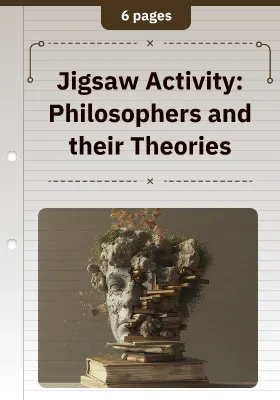
Jigsaw Activity: Philosophers and their Theories

Jigsaw Activity: Philosophers and their Theories

Objectives

The goal is to learn the Jigsaw method as a way to independently explore complex philosophical models of thought. Participants engage objectively and critically with fundamental questions of existence and evaluate them through academic discussion. The sample content serves as a flexible template for systematic method training.

Content and Methods

This Worksheet uses a cooperative Jigsaw structure to explore core philosophical ideas. After an individual specialization phase, students deepen their knowledge in expert groups and then share it in home groups. Results are organized in a table that highlights major works and key theses. A short, fictional role-play at the end places each position in a contemporary context. All content choices - both the selection of philosophers and the theories - are designed to be interchangeable.

Competencies

  • Subject Knowledge: Understanding central philosophical movements and the ability to concisely summarize complex models of thought.
  • Methodological Skills: Confident use of the Jigsaw method as a cooperative learning approach and proficiency in focused academic research.
  • Critical Judgment: Objective engagement with differing worldviews and their relevance for contemporary epistemology.
  • Social and Communication Skills: Responsible peer-to-peer knowledge sharing and facilitation of perspective-taking through role-play.

Target Group and Level

Middle and upper secondary

Englishnon-subject specific contentPhilosophyEthics