Wozu brauchen wir Regeln?

TT
by to-teach Team
10 pagesAb Klasse 6Philosophy, Ethics
Template

Loading preview…

Your worksheet

Enter a paragraph from the German penal code. Your students will question and evaluate this law.

Need an idea?

Popular topics from other teachers

How our AI templates work

  • Content gets adapted

    Examples, texts and tasks match your focus.

  • Method & structure stay

    The didactically reviewed structure of the template won't change.

Description

Zielsetzung: Ziel ist das Verständnis für die Notwendigkeit von Regeln und Gesetzen. Die Lernenden analysieren das Spannungsfeld zwischen Freiheit und Ordnung sowie die Folgen von Regelverstößen anhand eines variablen Gerüsts.

Inhalte und Methoden: Das Arbeitsblatt verknüpft Recht mit Ethik. Methodisch wird die Funktion von Gesetzen erarbeitet und durch die „Goldene Regel“ ethisch hinterfragt. Zum Einsatz kommen Textanalysen, Fallbeispiele, Video-Impulse und Plenumsdiskussionen zur Klärung von Interessenkonflikten.

Kompetenzen:

  • Urteilskompetenz: Rechtliche und moralische Bewertung von Handlungen (z. B. Goldene Regel)
  • Reflexionskompetenz: Analyse von Interessenkonflikten und Folgen von Regelbrüchen
  • Perspektivübernahme: Empathische Erschließung von Beweggründen beteiligter Personen
  • Sozialkompetenz: Konstruktive Diskussion über gesellschaftliche Werte und Handlungsalternativen

Zielgruppe und Niveau:

Ab Klasse 6
Similar worksheets

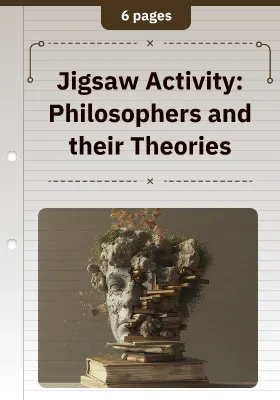
Jigsaw Activity: Philosophers and their Theories

Jigsaw Activity: Philosophers and their Theories

Objectives

The goal is to learn the Jigsaw method as a way to independently explore complex philosophical models of thought. Participants engage objectively and critically with fundamental questions of existence and evaluate them through academic discussion. The sample content serves as a flexible template for systematic method training.

Content and Methods

This Worksheet uses a cooperative Jigsaw structure to explore core philosophical ideas. After an individual specialization phase, students deepen their knowledge in expert groups and then share it in home groups. Results are organized in a table that highlights major works and key theses. A short, fictional role-play at the end places each position in a contemporary context. All content choices - both the selection of philosophers and the theories - are designed to be interchangeable.

Competencies

  • Subject Knowledge: Understanding central philosophical movements and the ability to concisely summarize complex models of thought.
  • Methodological Skills: Confident use of the Jigsaw method as a cooperative learning approach and proficiency in focused academic research.
  • Critical Judgment: Objective engagement with differing worldviews and their relevance for contemporary epistemology.
  • Social and Communication Skills: Responsible peer-to-peer knowledge sharing and facilitation of perspective-taking through role-play.

Target Group and Level

Middle and upper secondary

Englishnon-subject specific contentPhilosophyEthics