
My Rights - Self-Determination
Objective:
Learners should understand and actively exercise their fundamental rights, especially the right to self-determination and privacy. The goal is to empower them to recognize, communicate, and seek help regarding their personal boundaries.
Content and Methods:
The worksheet covers children's rights, privacy, bodily autonomy, and the protection of personal information. Content is delivered through exercises such as formulating "No," recognizing gut feelings, identifying personal data, and analyzing a case study. Methods include text comprehension, practical tasks, case analysis, and multiple-choice questions.
Competencies:
- Understanding and communicating rights (self-determination, privacy)
- Recognizing and expressing personal boundaries
- Making independent decisions
- Seeking help from trusted individuals
- Critical thinking in risk situations
Target Group and Level:
Grade 3 and above
Note:
Worksheet 3 from the series "My Body Belongs to Me"
Feelings and personal boundaries
The learners should develop an awareness of their own feelings and personal boundaries. The goal is to teach them to distinguish between good and bad touches, define their personal space, and learn appropriate responses in uncomfortable situations.
Content and Methods:
The worksheet begins with a "Feelings barometer," where students evaluate touch situations using emojis. Next, the concept of "personal space" is introduced, which learners will illustrate and define who may enter it. A text about an uncomfortable situation serves as a basis for partner work to reflect on feelings and reactions. A table for categorizing characteristics of "good" and "bad" touches, along with group work to gather examples, deepens understanding. Methods include self-assessment, creative design, text analysis, partner and group work, and categorization exercises.
Competencies:
- Recognizing and naming personal feelings related to touch
- Defining and communicating personal boundaries
- Distinguishing between acceptable and uncomfortable touches
- Reflecting on behaviors in potentially uncomfortable situations
- Collaboration and communication in partner and group work
Target Group and Level:
Grade 3 and up
Note:
Worksheet 2 from the worksheet series "My Body Belongs to Me."
Seeking Help and Finding Support
Students will be informed about ways to seek help and support after experiencing assault or harassment. The overarching goal is to convey that they are not alone, are not to blame, and that there are trustworthy individuals and organizations available to help them process trauma and lead a self-determined life.
Content and Methods:
The worksheet begins with an introduction emphasizing the importance of speaking out about assaults and seeking help. It introduces the concepts of a "support network" and "emergency contacts." Students are encouraged to identify trusted individuals in their personal lives. A reading passage about a selected support organization serves as a case study to highlight the type of support and prevention work the organization offers. Multiple-choice questions assess comprehension of the text. A group reflection and a list of web links to additional support resources complete the worksheet. Methods include partner work, self-reflection, text analysis, multiple-choice questions, and group reflection.
Competencies:
- Identifying and building a personal support network
- Understanding the importance of discussing distressing experiences
- Knowledge of professional support services
- Analyzing and evaluating information about support organizations
- Reflecting on personal feelings and the ability to provide reassurance
- Applying research skills through the use of provided links
Target Group and Level:
Grade 7 and up
Note:
Worksheet 4 of 4 from the series "My Body Belongs to Me" - Middle School Level
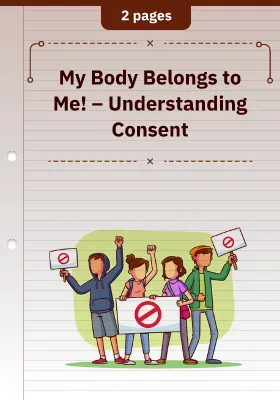
My Body Belongs to Me! – Understanding Consent
Students will develop a deep understanding of the concepts of "bodily autonomy" and "consent." The goal is to equip them with the ability to clearly communicate their own boundaries, respect the boundaries of others, and recognize the importance of voluntary and explicit consent in various areas of life.
Content and Methods:
The worksheet defines bodily autonomy and consent, emphasizing the importance of knowing, naming, and respecting one's own boundaries. A text example describes a situation where consent and uncertainties in a relationship are discussed. Reflection questions highlight the role of communication in maintaining consent. In partner work, students will discuss the relevance of consent beyond physical interactions. Methods include text analysis, reflection questions, partner work, and collecting examples.
Competencies:
- Understanding and defining the terms "bodily autonomy" and "consent"
- Recognizing and communicating personal boundaries
- Respecting the boundaries of others
- Analyzing the role of communication in achieving consent
- Applying the concept of consent to various areas of life
Target Group and Level:
Grade 7 and up
Note:
Worksheet 1 of 4 from the series "My Body Belongs to Me" - Middle School Level
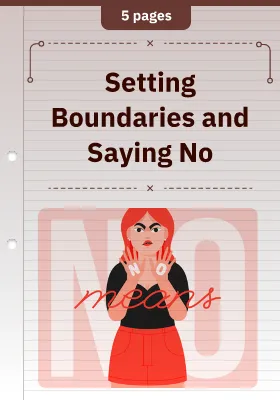
Setting Boundaries and Saying No
Learners learn to recognize and effectively communicate personal boundaries. The goal is to convey the importance of saying "No" as an act of self-protection and self-respect, empowering them to set boundaries clearly and politely in various situations.
Content and Methods:
The worksheet explains setting personal boundaries as a means of protecting one's well-being. It provides examples of physical, emotional, and digital boundaries. A case study serves as a basis for practicing how to say "No" clearly but politely. Learners reflect on the feelings that arise when saying "Yes" against their will and when saying "No." In partner work, situations where boundaries were unintentionally or deliberately crossed are discussed. Finally, learners identify trusted individuals and resources. Methods include text analysis, brainstorming, case studies, reflection questions, and partner work.
Competencies:
- Recognizing and naming personal boundaries
- Applying techniques for saying "No" in various situations
- Self-reflection on feelings when setting boundaries
- Analyzing situations where boundaries are crossed
- Identifying trusted individuals and resources
Target Group and Level:
Grade 7 and up
Note:
Worksheet 2 of 4 from the series "My Body Belongs to Me" - Middle School Level
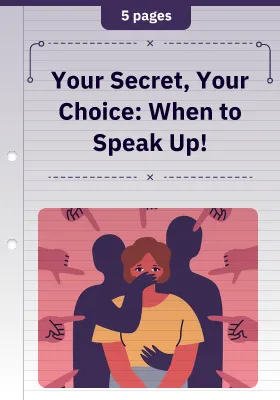
Your Secret, Your Choice: When to Speak Up!
Learners will develop a nuanced understanding of secrets and learn to distinguish between "good" and "bad" secrets. The goal is to empower them to actively seek help for "bad" secrets and to develop a personal emergency plan.
Content and Methods:
The worksheet differentiates between good and bad secrets, emphasizes gut feelings, and highlights situations where secrets should be shared with trusted adults. Learners will evaluate secrets, respond to scenarios, and complete a fill-in-the-blank exercise. Finally, they will create an emergency plan for bad secrets, including identifying trusted individuals and communication strategies. Methods include reading comprehension, decision-making, fill-in-the-blank tasks, and partner work.
Competencies:
- Distinguishing between good and bad secrets
- Recognizing signs of a "bad" secret (gut feeling, negative emotions)
- Understanding the necessity of sharing "bad" secrets
- Developing strategies for handling difficult situations
- Identifying and naming trusted individuals
- Communicating needs and concerns
Target Group and Level:
Grade 3 and up
Note:
Worksheet 4 from the series "My Body Belongs to Me!"
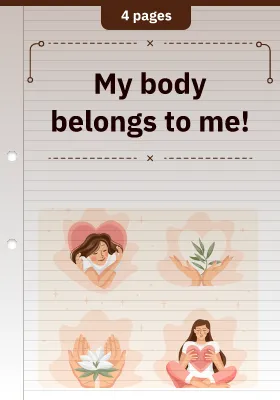
My body belongs to me!
Students should develop a fundamental understanding of the concept of bodily autonomy. The goal is for them to learn to say "no" when touches are unwanted, to take their feelings seriously, and to reach out to trusted individuals in uncomfortable situations.
Content and Methods:
The Worksheet explains the significance of "My body belongs to me!" and emphasizes the right to bodily autonomy. It includes a QR code linking to a YouTube song on the topic. The content is reinforced through practical tasks: drawing and labeling their own body, evaluating statements as true or false, and answering questions about specific situations where autonomy is required. Methods include text comprehension, creative design, true/false tasks, and situation-based reflection questions.
Competencies:
- Understanding the concept of bodily autonomy
- Expressing boundaries and saying "no"
- Recognizing and taking one's feelings seriously
- Identifying trusted individuals for support
- Making decisions regarding one's own body
Target Group and Level:
From Grade 3
Note:
Worksheet 1 from the "My Body Belongs to Me" series.
Body image disorder
Objective: The worksheet aims to teach learners about the concept of body image disorder and raise their awareness of the psychological effects of medical changes. It is designed to enable future nursing staff to provide sensitive support to patients experiencing shame, insecurity, and anxiety about their changed bodies.
Content and methods: The worksheet begins with a definition of body image and explains how a disorder develops. It initially focuses on the causes of body image disorders. It highlights the emotional and social effects such as shame and social withdrawal. Solutions such as professional support and self-help groups are mentioned. Learners are asked to summarize the text and answer open-ended questions about the effects of beauty ideals and media representations on body image. An exercise invites learners to reflect on their own body image and write a short letter to their body.
Skills:
- Psychological understanding: Learners understand the complex concept of body image disorder.
- Empathy: They learn to empathize with the emotional situation of patients with stomas.
- Self-reflection: They reflect on their own body image and its influence on their professional attitude.
Target group and level: Students and trainees