

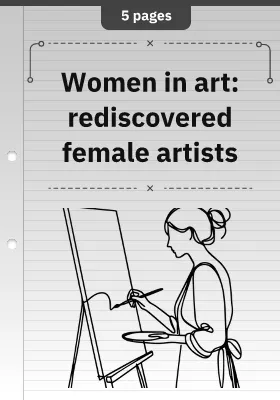
Women in Art: Rediscovered Female Artists
Objectives:
The learners examine the role of women in art history and reflect on why many female artists were overlooked or forgotten for a long time. Learners analyze and question the structures that have delayed the recognition of various women artists.
Content and methods:
The worksheet introduces the life and work of a female artist and shows why she was only recognized late despite her innovative works. Learners examine historical and social reasons for the marginalization of female artists and reflect on how the art world could change if women had received equal visibility and support from the outset. Through image analysis, expert statements and reflection questions, a critical examination of gender roles in art is encouraged.
Competencies:
- Analysis and interpretation of works of art in a historical and social context
- Critical reflection on structural inequalities in the art world
- Development of own questions on the representation of women in art history
Target group and level:
Grade 10 and above
Reading Comprehension Escape Room - Advanced
Das übergeordnete Lernziel des Arbeitsblattes ist es, die fortgeschrittene Lesekompetenz (Reading Comprehension) der Schüler:innen auf spielerische Weise durch ein englisches Escape-Room-Szenario zu trainieren und zu vertiefen.
Inhalte und Methoden: Das Arbeitsblatt behandelt inhaltlich verschiedene Abenteuer- und Schatzsuche-Szenarien. Methodisch ist das Material als mehrstufiges Rätsel (Escape Room) aufgebaut. Es kombiniert narrative und biografische Texte mit unterschiedlichen Aufgabenformaten: Die Lernenden müssen Vokabelbedeutungen aus dem Kontext erschließen, offene Verständnisfragen beantworten, Handlungsabläufe (Ursache und Wirkung) analysieren und abschließend einen Lückentext durch das Lösen verschiedener Rätsel vervollständigen.
Kompetenzen:
- Fortgeschrittenes Leseverständnis englischsprachiger Texte
- Selbstständige Wortschatzerschließung aus dem Textkontext
- Analytisches Denken (Erfassen von Ursache-Wirkungs-Zusammenhängen und chronologischen Abläufen)
- Problemlösefähigkeit und Kombinationsgabe beim Entschlüsseln von Texträtseln
Zielgruppe und Niveau: Englischlernende auf B2 Niveau
Role Cards (All Levels)
This worksheet aims to teach students how to explore the pros and cons of a complex scientific issue through a structured debate. It encourages them to understand and adopt different professional perspectives.
Content and methods: The worksheet introduces a controversial scientific and ethical dilemma. It utilizes a role-play methodology where students are assigned specific personas (such as a scientist, ecologist, bioethicist, or politician) with outlined responsibilities. Students engage in debate preparation by reading their role cards, anticipating opposing viewpoints, and drafting opening statements. Finally, it provides structured arguments and debate starters to facilitate an interactive, multi-perspective oral discussion.
Competencies:
- Role-playing and perspective-taking
- Argumentation and debate skills
- Critical thinking and ethical evaluation
- Public speaking and oral communication
Target group: Grade 3 and above
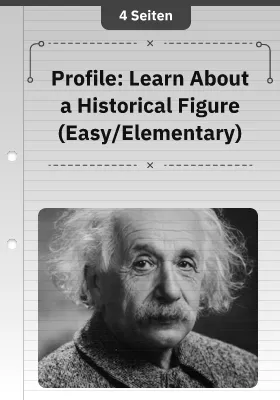
Profile: Learn about a Historical Figure (Easy/Elementary)
The learners deal with a historical personality.
Content and methodology: The learners read a basic text and can complete a profile based on it.
Competences:
- Reflection and discussion of the relevance of the selected person
- Reading skills
Level: Lower school (5th - 7th grade)
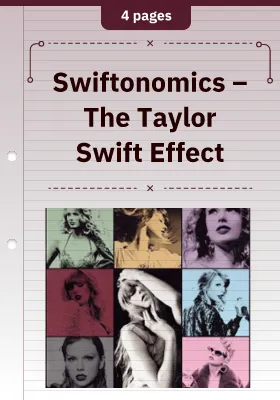
Swiftonomics – The Taylor Swift Effect
The worksheet aims to highlight the far-reaching economic, social and environmental impacts of a global concert tour, using Taylor Swift's ‘Eras Tour’ as an example.
Contents and methods:
Using multiple-choice questions, videos and factual texts, learners analyse ‘Swiftonomics’ and its influence on various economic sectors and a selected city. The tasks include knowledge tests, problem solving and opinion forming by developing their own proposals for sustainable events and justifying a decision as mayor.
Skills:
- Analysis and evaluation of economic relationships
- Critical thinking and argumentation
- Media literacy
- Reflection on social and environmental issues
Target group and level:
Grade 8 and above
Consumerism on holidays
Learners critically reflect on consumption on traditional holidays and understand the economic, social, and environmental impacts. They analyze different perspectives and evaluate their opportunities and risks.
Content and methods:
Through fictional dialogues and changes of perspective, learners examine consumer behavior on special days. They consider the views of various actors such as consumers, retailers, service providers, and environmental activists. With the help of reflection and analysis tasks, they develop a nuanced understanding of economic and social contexts.
Skills:
- Critical thinking and reflection
- Perspective taking and empathy
- Analysis of economic and social contexts
Target group and level:
Grade 8 and above
Economic sectors in the future
Learners identify the opportunities and challenges that will shape a specific economic sector in a country in the future. They deal with the perspectives of different actors and develop an understanding of the complexity of the industry.
Content and methods
The worksheet offers texts from the perspectives of environmental activists, entrepreneurs, consumers and politicians that shed light on the opportunities and challenges of the automotive industry. Learners classify these aspects in a table and reflect on how they influence each other. Finally, they develop their own recommendations for action and assess whether a given future scenario is realistic.
Competencies:
- Analytical thinking and problem solving
- Reflection on different perspectives
- Development of recommendations for action
- Critical analysis of future scenarios
Target group and level:
Grade 9 and above
Escape Room: Economic crisis
Learners understand the mechanisms of an economic crisis in a playful way and develop strategies for coping with it.
Content and methods:
Through an escape room scenario, learners deal with economic contexts. They have to solve tasks in groups in order to find ways out of the crisis.
Competencies:
- Analytical thinking and problem solving
- Cooperation in groups
- Application of basic economic knowledge
Target group and level:
Grade 9 and above
Films in the classroom
With the help of the worksheet, learners engage with the content of a film in a structured manner before, during and after viewing it in order to develop a deeper understanding and to reflect on and transfer what they have seen.
Content and methods:
The worksheet begins by testing prior knowledge of the film. While watching, the pupils complete multiple-choice tasks to actively engage with and consolidate their understanding. After the film, transfer tasks are used for further processing and reflection on the topic.
Skills:
- Activating and building on prior knowledge
- Concentrated extraction of information from a visual medium
- Analysis, reflection and transfer of film content
Target group and level:
Grade 7 and above
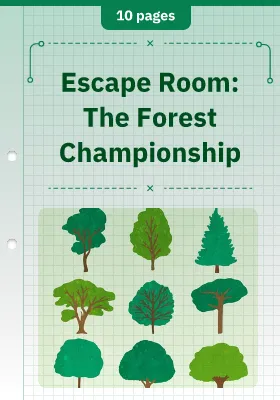
Escape Room: The Forest Championship
Students playfully immerse themselves in the world of trees, solve puzzles, and identify different tree species in order to find a “forest treasure” and break a “curse.”
Content and Methods:
In an escape room scenario, students solve various puzzles related to tree species. They must identify trees based on descriptions, fill in gaps in texts, evaluate statements about trees as true or false, and classify trees as deciduous or coniferous. The worksheet also encourages students to document the trees they find, e.g., through photos or drawings.
Skills:
- Knowledge of tree species
- Analytical thinking and problem-solving
- Reading comprehension and text analysis
- Classification and categorization
Target audience and grade level:
Grade 5 and up
Escape Room: The journey through time
This worksheet is designed as an “Escape Room: Time Travel” and is intended to introduce students to a selected historical era or period in a playful way. By solving various puzzles, they gain knowledge about the society and circumstances of the time, as well as key figures and their influence.
Content and Methods: The worksheet begins with a scenario in which the students’ time machine is trapped in a time loop, and they can only return to the present by solving puzzles. The first puzzle section provides an informational text about the selected era or period. Multiple-choice questions assess comprehension of the text. The second puzzle section includes two audio messages from key figures of the selected era or period. Writing tasks allow for a deeper engagement with the content of the audio messages. A word search puzzle with text-related terms serves as a playful way to review vocabulary. The final puzzle is a crossword puzzle with questions on key aspects of the worksheet. Afterward, the time travel ends, and the students begin their journey back to the present.
Skills:
- Historical knowledge: Students gain knowledge about the selected historical period, its characteristics, and key figures.
- Listening and reading comprehension
- Problem-solving and creativity: Puzzles and creative tasks promote problem-solving skills and imagination.
- Interdisciplinary thinking: The connection between society, science, and culture within a specific era is emphasized.
Target audience and grade level: 7th/8th grade
Important! Prior knowledge or an introduction to the selected era/period is recommended before working on the worksheet.
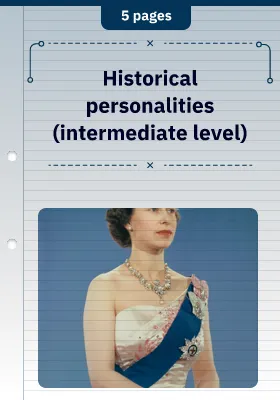
Historical personalities (intermediate level)
The learners engage with a historical personality. In doing so, they learn more about the personality's career, challenges and successes.
Content and methodology: Learners read a basic text and are able to answer comprehension questions and complete a profile based on this.
Competences:
- Reflection and discussion of the relevance of the selected person
Level: Intermediate (8th - 10th grade)
What if...? An alternative course of history
This worksheet introduces students to the concept of alternative historical outcomes and uses a fictional scenario to explore their impact on society, the economy, and politics. It promotes an understanding of the complexity of cause and effect, as well as critical thinking about human responsibility.
Content and Methods: The worksheet begins with an introduction to alternative historical scenarios as thought experiments. The main content is a fictional text on the chosen topic. Multiple-choice questions assess comprehension of the text. Two audio files explore the personal implications of this development. A concluding creative writing assignment challenges students to apply their learning.
Skills:
- Imagination and creativity: Students are encouraged to immerse themselves in a fictional scenario and develop creative solutions.
- Analysis of complex impacts: They recognize and analyze how a single event can have far-reaching political, economic, social, and ethical consequences.
- Awareness of issues and sense of responsibility: The scenario encourages reflection on human responsibility toward these developments.
- Media literacy: The ability to extract information from various media (text, audio) is promoted.
Target audience and grade level: 7th/8th grade (middle school)
Contemporaries in history - Who lived with whom?
Learners develop an understanding of a chosen period and the people who lived at that time.
Content and method: Using role cards, learners deal with three different historical figures from the same period. In doing so, they learn more about differences and similarities as well as their role in history. The worksheet is intended to provide a better overview of history in order to make interdependencies visible.
Competencies:
- compare and evaluate their own culture with other cultures in terms of their historical conditionality
- Recognize the possibilities and limits of individual and collective action in historical situations
- Analyze historical facts in their interdependencies (multi-causality)
Level: Intermediate
Talkshow Simulation
Learners simulate a talk show on a chosen topic.
Content and methods:
Learners watch a talk show together and discuss its structure, then sort the elements of a talk show. Afterwards, they look at the different roles that the participants and guests of talk shows have, and answer questions about them. Finally, they play a role in a talk show themselves - as a moderator or talk show guest.
Competencies:
- Viewing comprehension
- Answer multiple choice questions on a given topic
- Take on an expert role on a specific topic
- Perform research
Target group and level:
Grade 8 and higher