Philosophers of the World
Loading preview…
Choose a group of philosophers.
How our AI templates work
Content gets adapted
Examples, texts and tasks match your focus.
Method & structure stay
The didactically reviewed structure of the template won't change.
Description
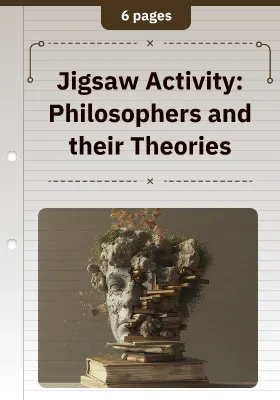
Objective: The overarching learning objective of this worksheet is to broaden students' understanding of philosophical thinkers from diverse cultures and to encourage critical engagement with their ideas and their relevance to contemporary issues.
Content and Methods: This worksheet introduces students to different philosophy, detailing its historical context, central themes such as the harmony of reason and faith, and key figures. It outlines their individual contributions and major works. The methods employed include reading informative texts, answering multiple-choice questions to assess comprehension, and engaging in analytical writing tasks such as explaining philosophical concepts, summarizing individual contributions, and applying historical philosophical ideas to current global problems, with a requirement to justify their potential helpfulness.
Competencies:
- Reading comprehension (understanding complex philosophical texts).
- Critical thinking (analyzing philosophical concepts and their relevance).
- Information synthesis (summarizing key ideas and contributions).
- Argumentation and evaluation (applying historical ideas to current problems and justifying their helpfulness).
- Cross-cultural understanding (exposure to non-Western philosophical traditions).
- Written expression (formulating clear and concise explanations and arguments).
Target Audience and Level:
Grade 8 and above
Similar worksheets


Theories - Applying and Exploring Them in Depth
The worksheet aims to provide students with a deep understanding of a pedagogical theory. Students apply central technical terms, transfer theoretical concepts to pedagogical scenarios, and reflect on the relevance of the theory for practical application.
Content and methods:
The focus is on the application, in-depth exploration, and critical reflection of an educational theory. Methodologically, the worksheet combines the translation of technical terms into everyday language, cooperative group work via an expert group method, the elaboration and presentation of subject-specific content, the development of practical case studies, the analysis of different positions and arguments, as well as a concluding reflection and self-assessment.
Competencies:
- Apply and explain central terms and concepts of a theory
- Comprehend, structure, and summarize specialized texts
- Transfer theoretical content to pedagogical situations and case examples
- Analyze and evaluate professional positions and arguments
- Formulate and justify personal judgments
- Reflect on and assess one's own learning progress
Target group and level:
Adult students or trainees in the field of social pedagogy, particularly aspiring educators.
Note on further work: The worksheet serves to deepen and apply a pedagogical theory. It can build upon an introductory worksheet and forms the foundation for further tasks in which theoretical concepts are applied to more complex practical examples and critically reflected upon. Introductory worksheet on the topic: Theories – Fundamentals
Note: Internet access is required for the group research phase.