

My body belongs to me
8

The world of Start Ups
5

AI skills
26
Substitute Lessons
16

Countdown to Summer
9
Focus on women
6
Mediation
6
Filters
Worksheets
Artificial Intelligence vs. Human Intelligence
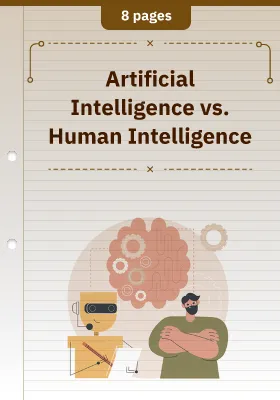
This worksheet aims to provide a comprehensive comparison between artificial and human intelligence, specifically focusing on the mechanisms of creativity and memory. It encourages students to critically evaluate the strengths and limitations of AI while reflecting on the unique qualities of human thought and emotion.
Content and methods: The worksheet employs a variety of pedagogical approaches, including comparative tables for self-assessment, creative writing prompts, and reflective questions based on personal experience. It integrates technical texts and a video lesson to explain AI learning models (supervised, unsupervised, and reinforcement learning) and human memory types (episodic, emotional, semantic, and sensory). The material concludes with a case study on AI in a professional field and a group discussion to synthesize the ethical and social implications of human-AI collaboration.
Competencies:
- Analytical thinking: Comparing cognitive processes between machines and humans
- Media literacy: Understanding different machine learning methods and AI data sources
- Reading and audiovisual comprehension: Extracting information from specialized texts and video content
- Creative and reflective writing: Producing original content and analyzing one's own creative influences
- Ethical evaluation: Discussing the impact of AI on society, trust, and professional fields
Target group: Grade 9 and above
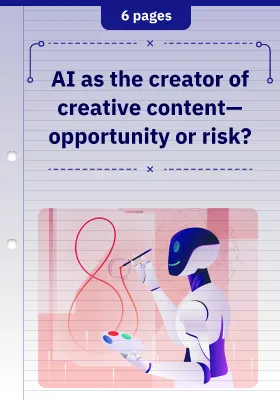
AI as the creator of creative content—opportunity or risk?
Learners critically examine the impact of generative artificial intelligence on the creative industries and develop their own well-founded position on the subject.
Content and methods:
The material provides an introduction to how generative creative content works. In a discussion, students take on different roles (e.g., politicians, tech industry, cultural workers), analyze subject-specific arguments, and compile them in a table. An optional practical task allows them to experiment with AI tools themselves.
Skills:
- Critical examination of technological innovations and their social consequences
- Change of perspective and ability to argue within the framework of a debate
- Media literacy through reflection on copyright, authenticity, and the dangers of manipulation
- Use of digital tools for creative content creation
Target group:
Grade 10 and above
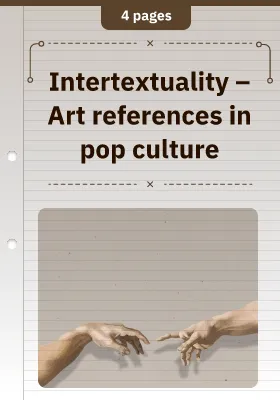
Intertextuality – Art references in pop culture
Students understand the principle of intertextuality in pop culture using the example of pop music videos and analyze the messages conveyed by them.
Contents and methods:
The worksheet uses a selected music video or song as a concrete reference point to examine the deliberate use of famous works of art (intertextuality). The method involves a step-by-step analysis of the work of art, the development of its art-historical background and a comparative interpretation of the original with the modern music video.
Skills:
- Analysis and interpretation
- Cultural and historical knowledge
- Transfer and comparison
Target group and level:
Grade 9 and above
Note: This worksheet does not include the video of the song in question; it must be found independently, e.g. on YouTube.
Films in the classroom: Brochure
With the help of the worksheet, learners engage with a film in a structured way in order to develop a deeper understanding and to reflect on and transfer what they have seen.
Contents and methods:
The worksheet is structured like a brochure and asks questions about the content and further questions about the film. The worksheet ends with a personal evaluation of the film.
Skills:
- Concentrated extraction of information from a visual medium
- Analysis, reflection and transfer of film content
Target group and level:
Grade 7 and above
Films in the classroom
With the help of the worksheet, learners engage with the content of a film in a structured manner before, during and after viewing it in order to develop a deeper understanding and to reflect on and transfer what they have seen.
Content and methods:
The worksheet begins by testing prior knowledge of the film. While watching, the pupils complete multiple-choice tasks to actively engage with and consolidate their understanding. After the film, transfer tasks are used for further processing and reflection on the topic.
Skills:
- Activating and building on prior knowledge
- Concentrated extraction of information from a visual medium
- Analysis, reflection and transfer of film content
Target group and level:
Grade 7 and above
Coloring Picture
Color in a picture on a topic of your choice
Content and methods: An image that can be colored in
Competencies:
- stay in the lines
Target group and level:
Elementary school
Smartphone Puzzle
Students learn to analyze information from various digital sources and link it logically in order to draw conclusions.
Content and Methodology: The worksheet offers an interactive puzzle task based around a found smartphone. The students analyze chat histories, pictures and an audio file to identify the owner of the smartphone.
Skills:
- Critical analysis of texts and media
- Logical thinking and reasoning
- Understanding historical and/or scientific contexts
Target Audience and Level: Suitable for teaching at lower secondary level.
Women in art: rediscovered female artists
Objectives:
The learners examine the role of women in art history and reflect on why many female artists were overlooked or forgotten for a long time. Learners analyze and question the structures that have delayed the recognition of various women artists.
Content and methods:
The worksheet introduces the life and work of a female artist and shows why she was only recognized late despite her innovative works. Learners examine historical and social reasons for the marginalization of female artists and reflect on how the art world could change if women had received equal visibility and support from the outset. Through image analysis, expert statements and reflection questions, a critical examination of gender roles in art is encouraged.
Competencies:
- Analysis and interpretation of works of art in a historical and social context
- Critical reflection on structural inequalities in the art world
- Development of own questions on the representation of women in art history
Target group and level:
Grade 10 and above
Well-known artists
Learners engage with art history by getting to know a well-known artist and their works. They reflect on the significance and influence of the artist on the art world and develop a deeper understanding of their work.
Content and methods:
The worksheet introduces learners to the work of a well-known artist. They explore the central meaning of the work and learn about the themes and techniques used. Learners reflect on how the artist has integrated social, political or cultural issues into their work. Through individual research and partner work, learners share their impressions and broaden their understanding.
Competencies:
- Exploring the work of an artist in a historical context
- Promoting critical thinking and reflection on art and society
- Ability to analyze and interpret works of art
- Communication and discussion of artistic ideas and their social relevance
Target group and level:
Grade 8 and above
Work analysis: Painting
Through structured image analysis, students develop an in-depth understanding of the formal design and content of a work of art. They learn to recognize artistic techniques, interpret symbolism and develop a well-founded interpretation.
Contents and methods:
The worksheet guides learners step by step through the analysis of a selected painting. With the help of key questions and categories, they examine the composition, coloring, lighting, perspective and symbolism of the work. Finally, they formulate an interpretation and reflect on the significance of the artwork in its historical and social context.
Competencies:
- Analytical thinking and understanding of images
- Ability to analyze art in terms of form and content
- Critical reflection and interpretation of works of art
- Research and presentation skills
Target group and level:
Grade 9 and above
Profile: Epochs of art
Learners create a profile of a selected art epoch in order to become familiar with its characteristic features, artists, works and social influences. They develop an understanding of the development of art history and the significance of individual epochs for modern art.
Contents and methods:
The worksheet guides learners through the creation of a profile of an art epoch. With the help of key questions and categories, they collect information on chronological classification, stylistic features, motifs, artists and examples of works. The profile can be adapted for any period in art history.
Skills:
- Research and information processing skills
- Understanding of art historical contexts
- Ability to analyze and present period characteristics
- Critical reflection on the influence of art on society and culture
Target group and level:
Grade 9 and above
Well-known artists (elementary school)
The learners discover a well-known artist and engage with their works of art. They then design their own picture with reference to the artist.
Content and methods:
A well-known artist is introduced by means of a short informational text. The learners learn about the life and artwork of this person, in particular about a well-known painting. They then design their own work of art and give it a suitable title.
Skills:
- Studying and describing works of art
- Creativity through creation of own pictures
- Expressing their own feelings and thoughts visually
- Finding titles for their own works of art
Target group and level:
Grades 3-4
Fetching more worksheets...
Next Page