

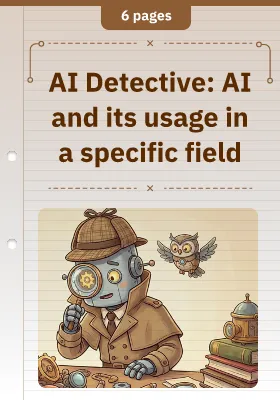
AI Detective: AI and its usage in a specific field
Students investigate how artificial intelligence is transforming a specific field, gaining an understanding of both the benefits and challenges of AI. The goal is to develop critical awareness of AI’s capabilities, ethical issues, and the ongoing need for human judgment in decision-making.
Content and Methods:
The worksheet guides students through an exploration of AI in a specific field by examining real-world examples. Students analyze ethical concerns. Methods include comprehension questions, multiple-choice tasks, comparison of benefits and risks, open-ended reflection questions, and a short argumentative essay about AI’s role in that field.
Competencies:
- Understanding technological applications of AI in a real-world professional field
- Critical evaluation of the benefits and risks of AI in that field
- Ethical reasoning about data privacy, bias, and human–machine interaction
- Analytical thinking about the balance between AI capabilities and human expertise
- Argumentative and reflective writing skills
Target Group and Level:
Grade 8 and up.
Prompt engineering
Learners will acquire the ability to formulate effective and precise prompts for AI systems (such as ChatGPT or Gemini) using a selected prompting method in order to achieve customized and structured results.
Content and methods:
The worksheet introduces a method of prompt engineering. It explains the logic behind this method and provides a detailed example prompt. The method is illustrated as a “blueprint” for the perfect prompt. Learners should apply the method to their own use cases and create a flashcard.
Skills:
- Methodological competence in dealing with AI systems
- Ability to structure complex tasks into logical, sequential steps
Target group:
Grade 7 and above
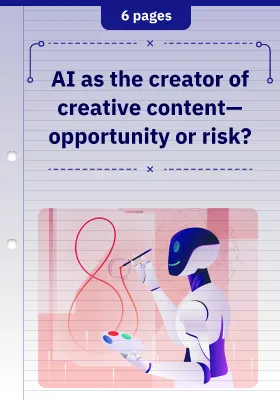
AI as the creator of creative content—opportunity or risk?
Learners critically examine the impact of generative artificial intelligence on the creative industries and develop their own well-founded position on the subject.
Content and methods:
The material provides an introduction to how generative creative content works. In a discussion, students take on different roles (e.g., politicians, tech industry, cultural workers), analyze subject-specific arguments, and compile them in a table. An optional practical task allows them to experiment with AI tools themselves.
Skills:
- Critical examination of technological innovations and their social consequences
- Change of perspective and ability to argue within the framework of a debate
- Media literacy through reflection on copyright, authenticity, and the dangers of manipulation
- Use of digital tools for creative content creation
Target group:
Grade 10 and above
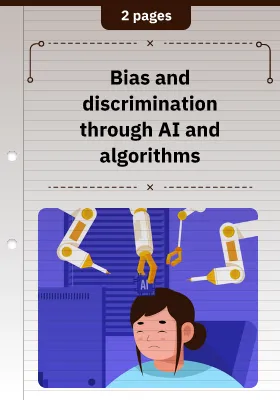
Bias and discrimination through AI and algorithms
Learners critically examine the supposed neutrality of algorithms and understand how AI systems can reproduce and cement social inequalities.
Content and methods:
The worksheet provides a theoretical introduction to the problems of machine learning and illustrates these using a case study. By analyzing factual texts and working through reflection questions, learners examine mechanisms such as the “black box problem,” proxy variables, and the ethical consequences of algorithmic decisions.
Skills:
- Recognizing bias in technical systems and questioning the objectivity of data.
- Discussing responsibility and accountability in the context of automated processes.
Target group:
Grade 11 and above.
History of AI
Students explore the origins of artificial intelligence (AI) and examine one stage of its development in detail.
Methods and content: The worksheet begins with the historical and philosophical roots of the idea of AI. Text analysis and multiple-choice questions are used to explore the philosophical foundations laid by René Descartes and Gottfried Wilhelm Leibniz. In the second part, practical developments are examined on the basis of a selected event. This involves analysing an audio source and completing transfer tasks. Finally, as an optional extra, a chronological sorting task can be completed as part of a video analysis to classify important historical milestones.
Skills:
- Critical thinking: Analysis of philosophical arguments and answering multiple-choice questions.
- Media literacy: Use of audio and video sources to obtain and summarise information.
- Transfer skills: Transferring historical observations to modern AI applications and evaluating their significance today.
Target group and level: From Year 7 onwards.
AI and emotions – can AI understand emotions?
The worksheet introduces pupils to the complex interplay between human psychology, biology and modern technology. It examines how humans experience emotions and whether artificial intelligence (AI) is capable of “understanding” them.
Content and methods: Learners first explore the basics of our emotions. They then learn more about how AI works to read emotions in an informational text. Afterwards, they take a closer look at the current possibilities of AI in a video clip. In both cases, learners are given comprehension questions. Finally, learners read a diary entry about a selected emotion. The learners work out whether the text was written by AI or by a human being.
Competencies:
- Technical competence: Acquisition of specialist knowledge about biological chain reactions and technological pattern recognition
- Judgement skills: Critical reflection on the use of emotion AI in the classroom and evaluation of ethical and practical consequences
- Analytical skills: Examination of texts (diary entry) for emotional authenticity and differentiation between human language and AI-generated structures
Target group and level: 8th - 10th grade
Artificial intelligence: How does it work?
Learners critically examine the effects of AI in everyday applications on individuals and society.
Content and methods: Learners first reflect on where they encounter AI in everyday life in a mind map. This provides a good introduction to the topic. Alternatively, a video is provided that addresses AI in everyday life and can be used as a further introduction. Learners then examine an Instagram post and a newspaper article that shed light on how a selected AI application works in everyday life. Open-ended questions are provided to deepen their understanding of the content. Based on this, learners watch a video from the "kurzgesagt" on the future of artificial intelligence and society. A related assignment is given.
Skills:
- Technical expertise
- Critical reflection on AI and its everyday uses
- Global perspective
Target group and level: Grade 8 and above
Develop Classroom Policies
This worksheet aims to guide students through a reflective and collaborative process to establish clear guidelines for the ethical and effective use of AI in their academic work. It moves from the general importance of rules in society to the specific application of integrity and responsibility when using emerging technologies.
Content and methods: The worksheet begins with a conceptual introduction to the necessity of rules using analogies from sports and traffic to illustrate fairness and safety. It then transitions into a critical discussion on AI, prompting students to analyze how these tools impact critical thinking, learning, and accuracy through open-ended questions. Finally, the worksheet provides concrete suggestions for classroom policies and concludes with a collaborative signing of a "class contract" to ensure mutual commitment.
Competencies:
- Critical Thinking: Evaluating the reliability and impact of AI-generated information
- Media Literacy: Understanding the operational mechanics and ethical implications of AI tools
- Social Responsibility: Collaborating on shared rules to ensure fairness and trust within a community
- Academic Integrity: Practicing proper citation and distinguishing between supplemental aid and plagiarism
Target group: High school students (Grades 9 and above)
Artificial Intelligence vs. Human Intelligence
This worksheet aims to provide a comprehensive comparison between artificial and human intelligence, specifically focusing on the mechanisms of creativity and memory. It encourages students to critically evaluate the strengths and limitations of AI while reflecting on the unique qualities of human thought and emotion.
Content and methods: The worksheet employs a variety of pedagogical approaches, including comparative tables for self-assessment, creative writing prompts, and reflective questions based on personal experience. It integrates technical texts and a video lesson to explain AI learning models (supervised, unsupervised, and reinforcement learning) and human memory types (episodic, emotional, semantic, and sensory). The material concludes with a case study on AI in a professional field and a group discussion to synthesize the ethical and social implications of human-AI collaboration.
Competencies:
- Analytical thinking: Comparing cognitive processes between machines and humans
- Media literacy: Understanding different machine learning methods and AI data sources
- Reading and audiovisual comprehension: Extracting information from specialized texts and video content
- Creative and reflective writing: Producing original content and analyzing one's own creative influences
- Ethical evaluation: Discussing the impact of AI on society, trust, and professional fields
Target group: Grade 9 and above
Protecting personal data when using AI
Objective: The worksheet raises learners' awareness of protecting their privacy when using artificial intelligence. The aim is to develop a deep understanding of what “personal data” is, the risks involved in sharing it, and how to protect oneself from misuse through targeted security rules.
Content and methods: The content includes an age-appropriate introduction to sensitive personal data, the risks involved in the digital space, and the conscious use of passwords, apps, and one's own digital footprint. This is supplemented by case studies on data misuse and the development of specific security rules for everyday life. Methods include visual image analysis, multiple-choice tasks to consolidate knowledge, active categorization exercises, scenario-based case studies, and creative group work such as designing security posters to promote reflection and decision-making skills.
Competencies:
- Media literacy: Developing an awareness of one's “digital footprint” and protecting one's identity online
- Risk perception: Ability to recognize potential dangers such as identity theft or unauthorized data transfer via apps
- Action competence: Formulation and application of practical safety rules for everyday digital life
- Critical thinking: Questioning the trustworthiness of applications, even if they promise useful functions
Target group and level: From grade 7 and above
Areas of application for AI in the workplace
Objective: The worksheet aims to educate learners about the use of artificial intelligence in medical diagnostics. Learners should understand how AI systems support professionals, increase efficiency, and what ethical questions arise regarding responsibility and trust.
Contents and methods: The content includes an introduction to AI-supported imaging based on informational texts, analysis tables on areas of application, a practical case study, and an overview of the pros and cons of opportunities and risks. Methodologically, the content is taught through a combination of technical text work, structured analysis, case studies, and reflective exchange formats such as opinion rounds and evaluation surveys.
Competencies:
- Technical competence: Understanding how AI works in medical imaging and diagnostics.
- Ethical reflection competence: Critical examination of the question of who bears ultimate responsibility for AI-supported wrong decisions.
- Assessment competence: Weighing up the opportunities and challenges of technological innovations.
Target group and level: From grade 10 onwards.
AI and Accessibility
Objective: The worksheet raises learners' awareness of the potential of artificial intelligence to promote inclusion and accessibility. The aim is to understand how technological assistance systems can increase the independence of people with disabilities in everyday life.
Content and methods: The content includes an introduction to AI-supported assistance functions for people with disabilities, basic knowledge about this form of disability, typical barriers in everyday life, and ethical issues relating to data protection, accessibility, and the relationship between human and technical support. This is supplemented by practical case studies and the development of students' own app ideas as an application of what they have learned. The methods include the assignment and analysis of specific AI functions, theoretical impulses with hypothesis formation, empathic role-playing, scenario-based case work, creative project work on app design, and structured reflection and discussion phases on ethical aspects.
Competencies:
- Perspective taking: Developing empathy for the realities of life for people with disabilities
- Media and technology skills: Recognizing AI as a tool for assistive technologies
- Problem-solving skills: Transferring technological knowledge to complex everyday obstacles
- Ethical judgment: Critical examination of social conditions
Target group and level: Grade 8 and above
Phishing and fraud with AI
Objective: The worksheet serves to educate learners about cyber fraud, particularly phishing and the use of artificial intelligence. The aim is for learners to recognize fraudulent intentions in digital messages, understand how AI-supported attacks work, and learn effective prevention and immediate measures.
Content and methods: The content covers the recognition and classification of phishing attempts, typical characteristics of fake websites and messages, the influence of AI on the professionalization of digital scams, and strategies for prevention and correct action in the event of fraud. This is supplemented by an examination of language, image, and audio clues, as well as a critical evaluation of digital forms of communication. The methods include visual website analysis, structured information and text work, audio evaluations, action-oriented prevention exercises, and cooperative group work in which participants create their own sample messages and then reflect on and review them together.
Competencies:
- Media and information literacy: Recognizing psychological manipulation and technical obfuscation in digital media
- Analytical skills: Identifying warning signs in text and audio messages
- Action competence: Deriving and applying security rules for the digital space
- Critical thinking: Developing a healthy skepticism toward unexpected requests to disclose personal data
Target group and level: Grade 10 and above
Ethical Dilemmas - the Trolley Problem with AI
This worksheet aims to introduce students to the "trolley problem" as a fundamental ethical dilemma, encouraging them to evaluate moral decision-making through the lens of different philosophical theories and their modern application in artificial intelligence and autonomous driving.
Content and methods: The worksheet uses a multimedia approach, starting with a video-based discussion of the trolley scenario. It then provides informative texts on utilitarianism, deontology, virtue ethics, and moral relativism to facilitate theoretical understanding. Students apply these concepts through comprehension questions, analytical writing tasks, and a creative "pitch" presentation where they role-play as programmers to address the ethical challenges of self-driving cars.
Competencies:
- Ethical reasoning and moral judgment
- Application of philosophical theories to modern technology
- Critical thinking and perspective-taking
- Argumentation and presentation skills
- Reading and media literacy
Target group: Grade 10 and above
What is artificial intelligence and how does it work? (Intermediate level)
Objective: The worksheet provides a basic understanding of how artificial intelligence (AI) works at an intermediate level. Learners should be able to distinguish AI applications from classic programs, understand the technical learning process, and critically question algorithms in everyday life.
Content and methods: The content covers the basic definition of artificial intelligence, the distinction between static programs and adaptive systems, the three-step model of how AI works (data collection, pattern recognition, application), and the opportunities and risks of recommendation algorithms, such as filter bubbles and data bias. This is supplemented by practical case studies and the transfer of knowledge to school application scenarios. The methods include explanatory text work, tabular classifications, visual process diagrams to illustrate technical processes, analytical case studies, and creative transfer tasks in which learners take on developer roles to design their own AI ideas for everyday life.
Competencies:
- Technical understanding: Understanding the logic of algorithms and machine learning
- Judgment: Reflection on the limitations and error susceptibility of AI systems
- Design skills: Development of innovative solutions for one's own environment (school)
- Analytical skills: Distinguishing between different phases of the learning process using practical examples
Target group and level: From grade 8 onwards
What is artificial intelligence and how does it work? (Upper secondary level)
Objective: This worksheet provides an in-depth understanding of the technical fundamentals and ethical implications of artificial intelligence at the upper secondary level. The aim is to go beyond mere application and understand the underlying mechanisms (such as neural networks and machine learning) and critically reflect on their social implications.
Content and methods: The content covers fundamental technical concepts of artificial intelligence such as machine learning, deep learning, and neural networks, the distinction between weak and strong AI, and the analysis of everyday digital applications according to criteria such as data volume, algorithms, and learning ability. This is supplemented by practical case studies on personalized learning systems and ethical and social issues such as bias, responsibility, and the impact on learning and creativity. The methods include technical term explanations, comparative classification tasks, scenario-based case analyses, multi-perspective role-plays from different points of interest, and stimulating discussion and position exercises in the classroom, in which learners justify and reflect on their attitudes.
Competencies:
- Technical expertise: Confident use of technical terms such as algorithms, training data, and artificial neurons.
- Analytical skills: Ability to identify the role of training data and bias in AI models.
- Ethical judgment: Reflection on data protection and discrimination risks.
- Discussion and argumentation skills: Ability to represent complex positions within a role-play and in a plenary discussion
Target group and level: From grade 10 onwards
AI addiction
Objective: The worksheet serves to educate students about the growing phenomenon of artificial intelligence addiction. Students should be made aware of the line between helpful support and compulsive use, reflect on their own behavior, and develop strategies for a healthy balance.
Content and methods: The content covers the concept of AI addiction, typical characteristics of dependency such as loss of control, tolerance development, and withdrawal symptoms, as well as psychological and neurobiological causes. This is supplemented by case studies on problematic and risky use, opportunities and risks of intensive AI application, and strategies for prevention and healthy use in everyday life. The methods include self-tests and self-assessments of one's own usage behavior, explanatory information texts, comparative case analyses, structured reflection phases on warning signs and possible courses of action, as well as creative transfer tasks such as designing rule posters with dos and don'ts.
Competencies:
- Self-reflection skills: Ability to critically evaluate one's own digital usage behavior
- Analytical skills: Identification of psychological warning signs and long-term social consequences of addiction
- Action skills: Development of usage rules and solutions for regaining self-control
- Health competence: Understanding the effects of AI on emotion regulation and general well-being
Target group and level: From grade 8 onwards
The impact of AI on the labor market
Objective: The worksheet raises learners' awareness of how artificial intelligence is changing the world of work, focusing on the chosen profession as an example. The aim is to understand the shift from routine tasks to demanding human skills and to evaluate the resulting opportunities and risks.
Content and methods: The worksheet deals with the world of work, using a selected profession as an example. Methodologically, tasks that can already be performed by computers today are collected and structured in a mind map in order to examine changes in the job profile, such as the elimination of routine tasks or the emergence of new professions. In addition, opportunities (e.g., support with complex tasks) and risks (e.g., job loss for simple tasks) are critically examined, and a new job profile is developed that combines the strengths of humans and AI.
Competencies:
- Analytical skills: Ability to examine occupational fields for their potential for automation
- Technological adaptability: Recognition of the need for technical training in the use of AI system
- Critical thinking: Weighing economic efficiency against social impacts on employees
- Future planning: Development of innovative professional roles in a digitalized working world
Target group and level: Grade 10 and above
Fact-checking in the age of AI
Objective: The worksheet aims to raise awareness among learners about fake news and disinformation in the age of artificial intelligence. Students should learn not only to evaluate information intuitively, but also to apply systematic methods for verifying its accuracy.
Content and methods: In terms of content, the material deals with the distinction between intuition and fact-checking. It addresses the spread of myths and unconfirmed sensational reports on the internet. The methodological implementation involves evaluating fictional tweets, developing tips for identifying fake news using an external explanatory video, and applying the 5 steps of fact-checking (source, headline, comparison, evidence, AI suspicion) to a "breaking news" report.
Competencies:
- Media literacy: Developing a critical attitude toward digital content and its sources
- Analytical skills: Applying structured verification steps to assess credibility and warning signs
- Critical thinking: Questioning sensational headlines and secret sources.
- Technical understanding: Raising awareness of the potential of AI in the creation of disinformation.
Target group and level: Grade 7 and above
Where does AI get its information?
Objective: This worksheet addresses the key question of how artificial intelligence (AI) acquires its knowledge and how reliable this information is.
Content and methods: The material conveys that AI systems are not conscious beings, but are based on calculations derived from training data (e.g. books, articles, websites) and external sources (e.g., databases, news). The worksheet uses true/false tasks, text work, mind map creation for source overview, and practical case analyses to critically reflect on the functioning and reliability of AI.
Competencies:
- Media criticism: Recognizing that AI responses are based on probabilities and may be incorrect.
- Information research: Understanding the need to compare information from different sources (AI vs. books).
- Data protection awareness: Raising awareness of how user data is handled when interacting with AI.
Target group and level: Middle School
AI future scenarios – opportunities and risks
Objective: The worksheet aims to raise learners' awareness of the opportunities and risks associated with artificial intelligence (AI). They should learn to analyze different perspectives and make critical decisions in this controversial field of the future.
Content and methods: Learners first develop their own definition of artificial intelligence and are provided with a content basis through a case study. Using tables and role analysis, they evaluate opportunities and risks as well as the perspectives of various actors. Finally, they take a reasoned position in a decision-making task and reflect in a group on rules for the responsible use of AI.
Competencies:
- Understanding AI: Defining and distinguishing between the opportunities and risks of AI.
- Changing perspectives: Analyzing complex problems from different roles and attitudes.
- Critical thinking: Weighing technological progress against ethical and social risks.
- Decision-making skills: Developing well-founded decisions in a controversial context.
Target group and level: The worksheet is aimed at students from the 8th grade onwards and is also suitable for upper secondary school.
What is artificial intelligence (AI) and how does it work?
Objective: The worksheet provides a basic understanding of what artificial intelligence (AI) is, how it learns through training, and where it is used in everyday life. It sensitizes learners to the differences between human thinking and machine processing, as well as to the need for human support.
Content and methods: In terms of content, the worksheet teaches the basics of artificial intelligence, how it works using examples such as image recognition and AI-supported traffic light control, and its limitations in complex or unexpected situations. Methodologically, learners identify AI applications in everyday life, analyze a practical case study, and test their knowledge of AI with a true/false quiz. This promotes both theoretical understanding and critical reflection on the use of AI.
Competencies:
- Basic technical understanding: Understanding the principle of “learning from examples”
- Critical reflection: Recognizing that AI is prone to errors and requires human guidance
- Transferability: Linking abstract definitions to concrete everyday situations
Target group and level: Grade 3 and above
The impact of AI on the environment
Objective: The worksheet aims to raise learners' awareness of the environmental impact of artificial intelligence (AI). It trains them to critically analyse the energy and resource consumption of data centres in order to develop strategies for the environmental sustainability of AI technology, particularly through the use of renewable energies.
Contents and methods: The worksheet begins with a warm-up on the learners' personal attitudes towards AI and climate change, followed by information about AI data centres in a selected country/city. Learners analyse advantages and environmental risks using text and cause-and-effect analyses. Methods such as group research, perspective changing and decision-making encourage reflection on sustainability and concrete measures for environmental responsibility.
Competencies:
- Sustainability awareness: Understanding the ecological footprint of digital technologies (energy and resource consumption).
- Critical analysis: Weighing technological advantages (climate research, smart farming) against environmental risks.
- Problem solving: Developing concrete strategies to promote energy efficiency and the use of green energy sources for AI.
- Understanding of roles: Making informed political decisions from an environmental policy perspective.
Target group and level: Years 8–10 (middle school)
ESD:
- 12: Responsible consumption and production patterns: This addresses the challenge of raw material extraction (rare earths) and the need for recycling and sustainable procurement.
- 13: Climate action: The text highlights the role of AI in reducing global emissions and in climate research.
Official regulations on AI
Objective: The worksheet aims to teach learners about the official regulations governing artificial intelligence (AI). The focus is on the risk classification of AI applications, the fundamental rights of citizens and the balance between innovation and protection.
Contents and methods: The first phase of the worksheet serves as a warm-up and uses the method of joint idea gathering. The information text introduces the topic and explains key concepts such as risk assessment, transparency and data security. The methods include text comprehension by selecting the correct statement, classifying specific AI examples with justification, and reflective and creative forms of work such as open questions and designing a poster on the importance of AI regulation.
Competencies:
- Risk assessment: Ability to classify AI applications according to their potential risk to fundamental rights and security.
- Critical thinking: Weighing up the need for regulation in the context of innovation and risk protection.
- Communication: Formulating a reasoned opinion on AI regulation.
Target group and level: Years 8–10 (middle school)
ESD:
- 9: Industry, innovation and infrastructure: The Act aims to promote the responsible development of AI and maintain a balance between innovation and risk protection.
- 16: Peace, justice and strong institutions: The main purpose of the regulation is to protect the fundamental rights of citizens and create a uniform legal framework for AI technologies.

AI in Science Fiction vs Now
Students explore how artificial intelligence is portrayed in science fiction compared to real-world AI today, developing an understanding of the ethical, social, and technological implications of AI through analysis and creative application.
Content and Methods:
The worksheet focuses on comparing AI in a work of Science-Fiction with present-day AI developments. Students analyze AI capabilities, goals, human–AI interactions, and societal responses. Methods include guided comparative research, critical questioning, and a creative design task where students create a movie poster for a fictional AI sequel that connects science fiction themes with current realities.
Competencies:
- Analytical thinking and critical comparison of fictional and real-world AI
- Understanding ethical and social implications of AI technologies
- Creative transfer and visual communication through media design
- Reflection on human–machine relationships and societal impact
Target Group and Level:
Grades 9 and up.
AI through the Science-Fiction lens: what we can learn from Sci-Fi
Students analyze artificial intelligence in a work of science-fiction to understand how science fiction reflects societal values, fears, and hopes about technology and humanity. The overarching goal is to encourage critical reflection on ethical and philosophical questions surrounding AI and its implications for the future.
Content and Methods:
The worksheet guides students through a multi-step exploration of a work of science-fiction, including:
- Comprehension and analysis of the film’s or novel's plot and themes.
- Multiple-choice interpretation of key ethical, philosophical, and symbolic elements.
- Historical contextualization of the film’s creation and its relevance to early 21st-century technology.
- Open-ended reflection or essay tasks requiring students to explore ethical frameworks (e.g., utilitarianism, deontology, virtue ethics) or develop AI policy proposals.
- Methods include analytical reading, critical discussion, and creative or argumentative writing.
Competencies:
- Critical analysis of media and literature in relation to societal and ethical questions
- Understanding and application of philosophical frameworks
- Ethical reasoning and argumentation
- Historical contextualization of technological developments
- Reflective and analytical writing skills
Target Group and Level:
Grade 10 and up